WireByte
  • Log In
  • Sign Up
  • AI & Machine Learning
  • Technology
  • Science
  • Space & Astronomy
  • Gaming & Esports

Welcome Back

Log in to your WireByte account

Don't have an account? Sign Up

Create Account

Join WireByte for a personalized experience

Select your favorite categories:

Already have an account? Log In

Stay in the Loop

Get the stories that matter, delivered to your inbox.

You're all set! Check your inbox for a welcome email.

What do you want alerts for?

Search
Trending
WireByte
AI & Machine LearningTechnologyScienceSpace & AstronomyGaming & Esports

Home / AI & Machine Learning

South Korea Education Minister Resigns Over AI Cheating Scandal
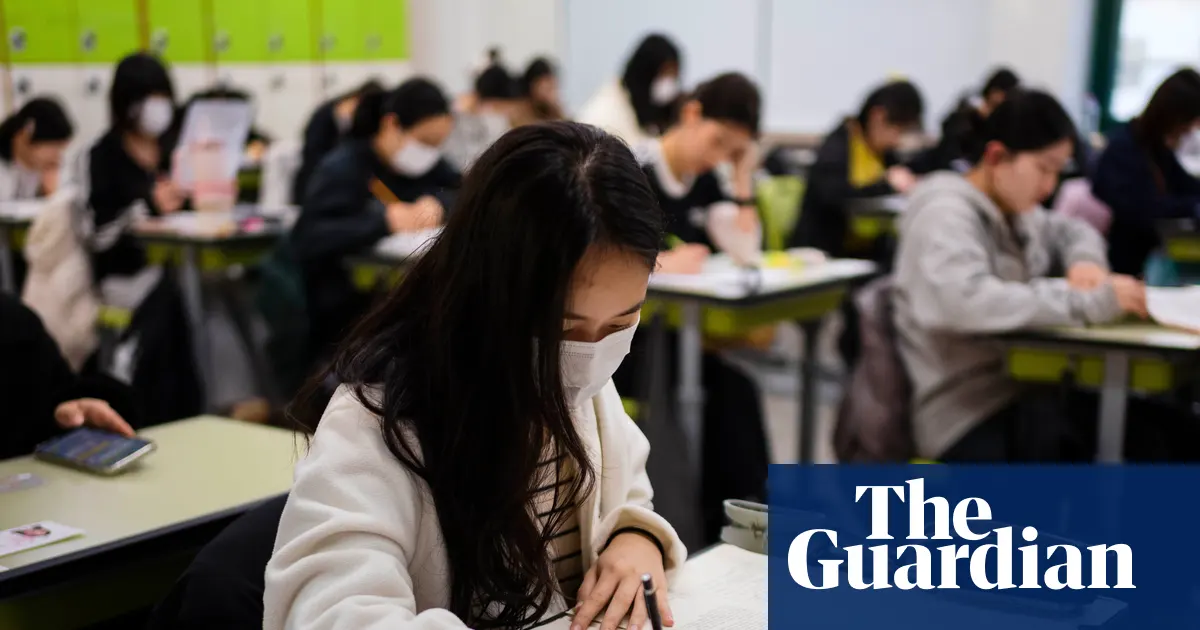
Image: © The Guardian
AI & Machine Learning

South Korea Education Minister Resigns Over AI Cheating Scandal

WireByte Staff · November 22, 2026

South Korea’s education minister resigned following a scandal where AI and hidden cameras were used to cheat in national exams. The crisis peaked before the high-stakes suneung university entrance test, sparking public outrage over inadequate security. The minister accepted responsibility for failing to prevent cheating, marking a significant moment in the nation's battle against technology-facilitated academic dishonesty.

Key points

  • South Korea's Education Minister Choi Kyo-jin resigned after failing to prevent AI-assisted cheating during the national university entrance exam, known as the suneung.
  • The scandal began when a top scorer in a tax accountant exam confessed to using a miniature camera and smartphone to achieve a near-perfect score.
  • The suneung is an eight-hour exam that determines university admission and future career prospects for South Korean students.
  • Despite last-minute preventive measures like blocking public Wi-Fi, critics argued the government's response was belated and inadequate.
  • President Lee Jae Myung accepted the minister's resignation, acknowledging the failure to prepare adequately for the security breach.
  • The incident has intensified global scrutiny on how educational systems are adapting to the rapid advancement of artificial intelligence tools.

A Crisis of Confidence in Education

South Korea’s education minister, Choi Kyo-jin, has officially resigned following a widespread scandal involving artificial intelligence-assisted cheating during the country’s most critical university entrance examinations. The resignation marks the end of a tumultuous period for the Ministry of Education, which faced intense public scrutiny and criticism for its handling of the security breach. The scandal erupted just days before the suneung, an eight-hour exam that serves as the primary gateway for students to enter prestigious universities and secure future career prospects.

The crisis began to unfold last Sunday when a top scorer in a national tax accountant exam confessed to using a miniature camera and a smartphone to cheat. This confession sent shockwaves through the educational community and prompted officials to scramble for preventive measures. With the crucial suneung exam scheduled for just four days later, the government rushed to implement security protocols, including blocking public Wi-Fi in testing areas to prevent students from accessing AI tools or external help.

The Scale of the Scandal

The suneung is not merely an academic test; it is a high-stakes event that determines the trajectory of a student’s life. The exam’s importance is such that it is often referred to as a national crisis, with entire cities slowing down to ensure candidates can focus. The revelation that AI and hidden cameras were used to cheat in a related national exam raised fears that the suneung might also be compromised. Despite the last-minute security upgrades, the education minister struggled to reassure the public that the exam would be fair and secure.

Teachers’ unions and other educational stakeholders criticized the government’s response as belated and insufficient. Many argued that the authorities should have anticipated the risks posed by advancing AI technology and implemented more robust preventive measures well in advance. The perception of a reactive rather than proactive approach fueled public anger and eroded trust in the education system’s ability to maintain integrity.

Minister’s Resignation and Accountability

In a statement posted on X, Education Minister Choi Kyo-jin acknowledged the failure to prepare adequately for the security challenges. He wrote, “The exam concluded without any major incidents … However, as the minister in charge, I do not believe I am immune from public criticism that we failed to prepare adequately in advance.” Choi emphasized that while the exam itself proceeded without major disruptions, the lack of prior preparation warranted his resignation. He stated, “Now that the exam is over, I take full responsibility and hereby offer my resignation.”

President Lee Jae Myung accepted the resignation, as confirmed by the presidential office. The acceptance of the resignation underscores the severity of the scandal and the government’s recognition of its failure to protect the integrity of the national examination system. The incident has sparked a broader debate about the role of technology in education and the need for updated security measures to combat cheating in the digital age.

Global Implications and Future Steps

The South Korean scandal has drawn international attention, highlighting the challenges that educational systems worldwide face in the era of rapid technological advancement. As AI tools become more sophisticated and accessible, the potential for cheating in high-stakes exams increases. The incident serves as a wake-up call for other countries to reassess their exam security protocols and consider the ethical implications of AI in education.

In the aftermath of the scandal, the South Korean government is expected to launch an investigation into the extent of the cheating and the effectiveness of the preventive measures. The findings could lead to significant changes in how national exams are administered and secured. Additionally, the incident may prompt a reevaluation of the suneung itself, with some calling for reforms to reduce the pressure on students and the reliance on a single exam for university admission.

Key takeaways

  • South Korea’s Education Minister Choi Kyo-jin resigned due to the AI cheating scandal during the suneung exams.
  • The scandal began with a confession of cheating in a tax accountant exam using a miniature camera and smartphone.
  • The suneung is an eight-hour exam critical for university admission and future career prospects.
  • Critics argued the government’s last-minute security measures, like blocking Wi-Fi, were insufficient and belated.
  • President Lee Jae Myung accepted the resignation, acknowledging the failure to prepare adequately.
  • The incident highlights global challenges in maintaining exam integrity in the age of advanced AI technology.

Sources

  • theguardian.com
WireByte Staff — Editorial Team

The WireByte editorial team synthesises technology news from multiple primary sources, verifies the facts, and links every source. Articles are produced with AI assistance and reviewed under our editorial policy.

More in AI & Machine Learning

OpenRouter Removes Providers Over Data Retention Concerns

OpenRouter Removes Providers Over Data Retention Concerns

OpenRouter has offboarded three inference providers and revoked Zero Data Retention stat…

Homelabber Runs 2.8T Kimi AI Model Using RTX 3090s and Optane

Homelabber Runs 2.8T Kimi AI Model Using RTX 3090s and Optane

A tech enthusiast successfully runs the 2.8-trillion-parameter Kimi K3 AI model on a cus…

Rockstar Details NPC AI and World Design in GTA 6 Preview

Rockstar Details NPC AI and World Design in GTA 6 Preview

Rockstar Games has revealed new details on Grand Theft Auto VI's non-player character (N…

Google Launches Gemini 4 Neon AI Model for Complex Workflows

Google Launches Gemini 4 Neon AI Model for Complex Workflows

Google has released Gemini 4 Neon, an AI model optimized for software engineering and kn…

Latest

Captain Kirk's 'Risk is Our Business' Named Greatest Sci-Fi Quote

Captain Kirk's 'Risk is Our Business' Named Greatest Sci-Fi Quote

A recent analysis identifies Captain James T. Kirk’s line “Risk is our business” from St…

Toyota, Nissan, Honda Standardize Parts to Cut Costs

Toyota, Nissan, Honda Standardize Parts to Cut Costs

Japan's top three automakers—Toyota, Nissan, and Honda—have agreed to standardize intern…

Global Tech Outages: Coincidence or Coordinated Attack?

Global Tech Outages: Coincidence or Coordinated Attack?

A series of widespread IT failures affecting airlines, banks, and tech giants sparked gl…

Berlin Club Apologizes After Military AI Launch Event Sparks Outrage

Berlin Club Apologizes After Military AI Launch Event Sparks Outrage

Kraftwerk Berlin apologized for hosting Helsing’s Clarity AI launch, describing it as a …

Home Network Congestion: Why More Devices Don't Always Mean Better Speed

Home Network Congestion: Why More Devices Don't Always Mean Better Speed

Connecting numerous devices to a home network can cause severe congestion, leading to bu…

Samsung and LG Battle for OLED TV Supremacy Amid Tech Disputes

Samsung and LG Battle for OLED TV Supremacy Amid Tech Disputes

Samsung and LG dominate the OLED TV market, each leveraging distinct panel technologies.…

Related articles

OpenRouter Removes Providers Over Data Retention Concerns AI & Machine Learning OpenRouter Removes Providers Over Data Retention Concerns WireByte

OpenRouter has offboarded three inference providers and revoked Zero Data Retention status for 125 endpoints following security research indicating data policy violations. While no breach of OpenRouter’s own systems was detected, the platform is notifying affected customers and enhancing monitoring protocols to ensure strict adherence to privacy commitments in the AI model aggregation space.

WireByte Staff · November 22, 2026

Homelabber Runs 2.8T Kimi AI Model Using RTX 3090s and Optane AI & Machine Learning Homelabber Runs 2.8T Kimi AI Model Using RTX 3090s and Optane WireByte

A tech enthusiast successfully runs the 2.8-trillion-parameter Kimi K3 AI model on a custom homelab setup featuring two RTX 3090 GPUs and Intel Optane memory. By offloading nearly half the model to a RAM drive, generation speed reached 3.11 tokens per second, a 41% improvement. The build requires significant cooling due to high heat output from the persistent memory.

WireByte Staff · November 21, 2026

Rockstar Details NPC AI and World Design in GTA 6 Preview AI & Machine Learning Rockstar Details NPC AI and World Design in GTA 6 Preview WireByte

Rockstar Games has revealed new details on Grand Theft Auto VI's non-player character (NPC) systems, emphasizing unique personalities and reactive behaviors to create a living world. The studio dedicated a specific team to ensure authenticity in dialogue and interactions, with over 100 explorable interiors adding narrative depth to the setting of Leonida.

WireByte Staff · November 21, 2026

Google Launches Gemini 4 Neon AI Model for Complex Workflows AI & Machine Learning Google Launches Gemini 4 Neon AI Model for Complex Workflows WireByte

Google has released Gemini 4 Neon, an AI model optimized for software engineering and knowledge work. Priced at $3 per million input tokens, it claims superior performance against rivals like Claude Opus 5.5 and GPT-6.2 Sol. The launch targets enterprise efficiency, offering enhanced capabilities for long-running agentic tasks while maintaining strict safety safeguards.

WireByte Staff · November 21, 2026

Captain Kirk's 'Risk is Our Business' Named Greatest Sci-Fi Quote Business & Economy Captain Kirk's 'Risk is Our Business' Named Greatest Sci-Fi Quote WireByte

A recent analysis identifies Captain James T. Kirk’s line “Risk is our business” from Star Trek’s second season as the franchise’s most significant dialogue. The quote, spoken in the episode “Return to Tomorrow,” is argued to better encapsulate Star Trek’s core themes of exploration and bravery than more famous catchphrases like “Live long and prosper.”

WireByte Staff · November 22, 2026

Toyota, Nissan, Honda Standardize Parts to Cut Costs Latest Toyota, Nissan, Honda Standardize Parts to Cut Costs WireByte

Japan's top three automakers—Toyota, Nissan, and Honda—have agreed to standardize internal vehicle components, including steel quality, plastic protocols, and wiring harness codes. Announced by JAMA chairman Koji Sato, the initiative aims to reduce production expenses by leveraging shared supply chains for non-visible parts, with international suppliers to join soon.

WireByte Staff · November 22, 2026

WireByte

Tech & AI news, synthesised and to the point.

Delivering original syntheses and breaking news with cited sources. Stay informed with WireByte.

Sections

  • AI & Machine Learning
  • Technology
  • Science
  • Space & Astronomy
  • Gaming & Esports

Company

  • About Us
  • Editorial Policy
  • Privacy Policy
  • Contact: [email protected]

Newsletters

Get the stories that matter, delivered to your inbox.

© 2026 WireByte. All rights reserved. Original syntheses with cited sources.

Home Search