Unkernel Project Compiles Linux Kernel to WebAssembly
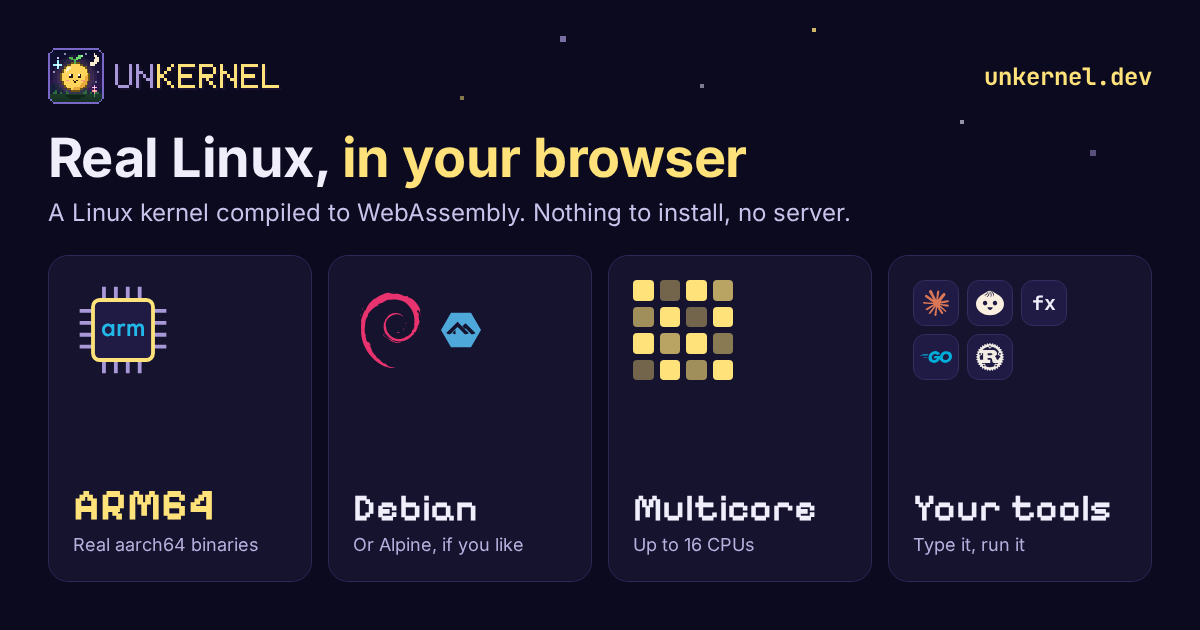
The Unkernel project demonstrates compiling the Linux kernel to WebAssembly, enabling kernel execution in browsers. This technical achievement allows developers to run and test kernel code without virtual machines or containers, potentially simplifying development workflows and enhancing security testing environments.
Key points
- Unkernel, a technical project, has successfully compiled the Linux kernel to WebAssembly for execution in web browsers.
- The project enables developers to run and test Linux kernel code directly in browser environments without traditional virtual machines.
- This approach offers a lightweight alternative to containers and VMs for kernel development and security testing.
- The initiative highlights the growing capability of WebAssembly to handle complex system-level software beyond standard web applications.
- The project is currently available for exploration by developers interested in low-level systems programming and browser-based environments.
Unkernel Breaks New Ground in Browser-Based Kernel Execution
A new project named Unkernel has demonstrated the ability to compile the Linux kernel to WebAssembly, allowing the operating system's core components to run directly within web browsers. This development marks a significant technical milestone, as WebAssembly has traditionally been limited to user-space applications rather than system-level software. The project, which has garnered attention from the developer community, showcases how modern web technologies can be leveraged for tasks previously confined to dedicated hardware or virtualized environments.
Technical Implementation and Capabilities
The core achievement of Unkernel lies in its compilation process, which transforms the Linux kernel into a WebAssembly module. This allows the kernel to execute within the browser's sandboxed environment, bypassing the need for traditional virtual machines or containerization technologies. Developers can now interact with kernel functions directly through the browser interface, providing a unique testing ground for kernel modifications and security research. The project does not replace the host operating system but rather runs alongside it, utilizing the browser as a runtime environment for kernel code.
Implications for Developers and Security Researchers
For developers, Unkernel offers a streamlined workflow for kernel development and testing. Traditionally, testing kernel changes required setting up complex virtual machine configurations or using specialized hardware. With Unkernel, these processes can be simplified, allowing for rapid iteration and debugging. Security researchers may also find value in this approach, as it provides an isolated environment for analyzing kernel vulnerabilities without risking the host system. The ability to run kernel code in a browser-based sandbox could facilitate collaborative security audits and educational demonstrations.
WebAssembly's Expanding Role in Systems Programming
The Unkernel project underscores the evolving capabilities of WebAssembly, a binary instruction format designed for efficient execution in web browsers. While initially intended for web applications, WebAssembly's performance and security features have made it increasingly suitable for more complex computing tasks. By successfully compiling the Linux kernel, Unkernel demonstrates that WebAssembly can handle system-level programming challenges, potentially opening new avenues for cross-platform development and distributed computing. This trend aligns with broader industry efforts to extend WebAssembly's reach beyond the browser.
Community Response and Future Directions
The Unkernel project has received positive feedback from the developer community, with many praising its innovative approach to kernel execution. Discussions on platforms like Hacker News highlight the technical sophistication of the project and its potential applications. While the project is still in its early stages, it has sparked interest in further exploring WebAssembly's role in systems programming. Future developments may include support for additional kernel features, improved performance, and integration with existing development tools. The project serves as a proof of concept, encouraging further experimentation with WebAssembly in low-level computing contexts.
Key takeaways
- Unkernel compiles the Linux kernel to WebAssembly for browser execution.
- The project eliminates the need for virtual machines or containers for kernel testing.
- Developers can use Unkernel for simplified kernel development and debugging workflows.
- Security researchers benefit from an isolated environment for vulnerability analysis.
- The initiative highlights WebAssembly's expanding role in systems-level programming.
- Community interest suggests potential for future enhancements and broader adoption.
Sources
The WireByte editorial team synthesises technology news from multiple primary sources, verifies the facts, and links every source. Articles are produced with AI assistance and reviewed under our editorial policy.