Google Open-Sources AI Model for Improved Hurricane Warnings
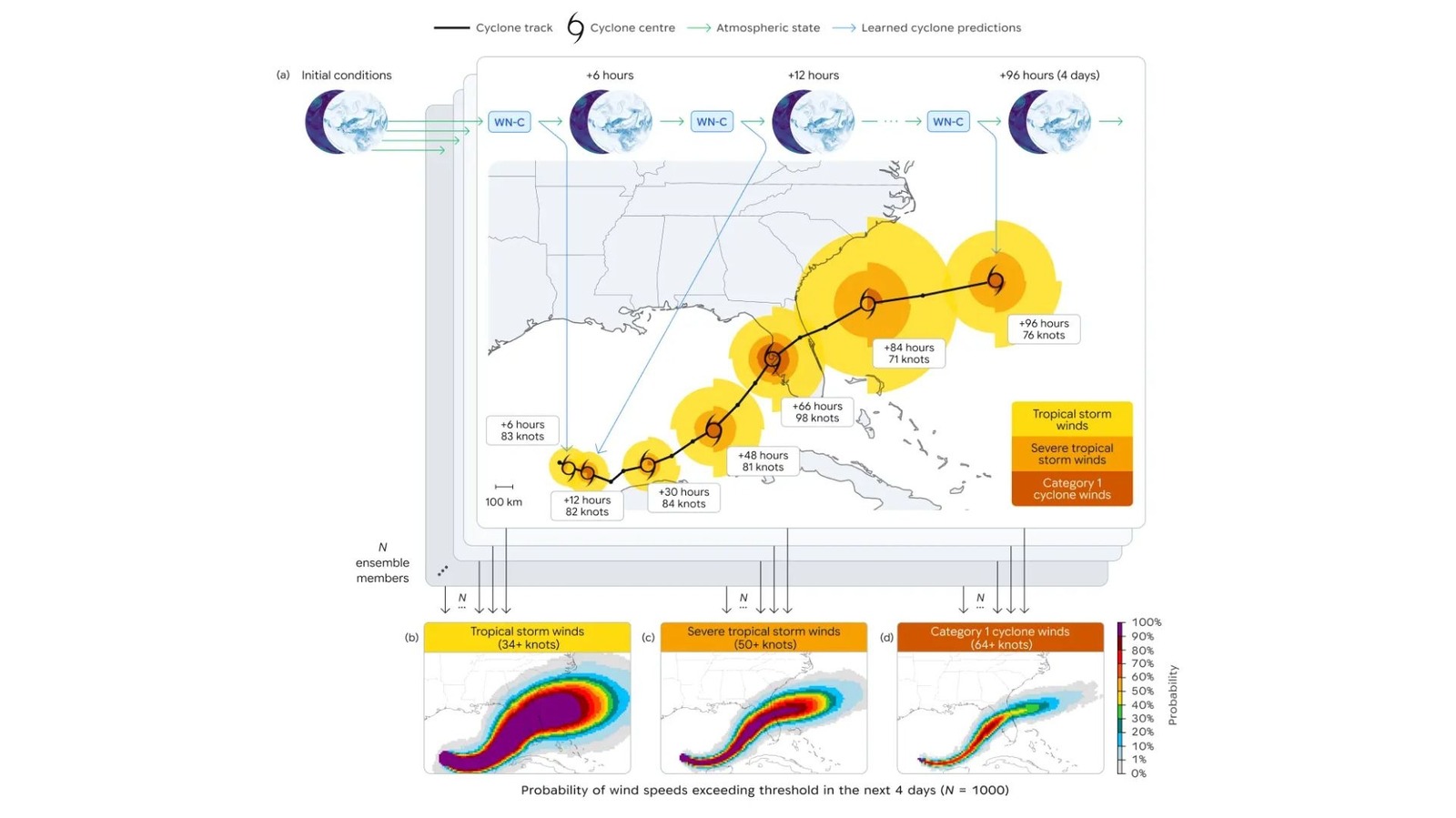
Google has released an open-source AI model called WeatherNext, which can predict a storm's track and intensity up to 15 days in advance. Developed with international weather agencies, the model uses nearly 20 terabytes of global atmospheric data and can generate a forecast in under a minute. This could lead to earlier warnings and potentially save lives. The model's code and weights are available on GitHub for other scientists to use.
Key points
- Google has open-sourced an AI model called WeatherNext, developed with international weather agencies, to improve hurricane warnings.
- WeatherNext can predict a storm's track and intensity up to 15 days in advance, using nearly 20 terabytes of global atmospheric data.
- The model can generate a forecast in under a minute, potentially allowing for earlier warnings and saving lives.
- The code and weights behind WeatherNext are available on GitHub for other scientists to use and build upon.
Google Open-Sources AI Model for Improved Hurricane Warnings
Google has released an open-source AI model called WeatherNext, which can predict a storm's track and intensity up to 15 days in advance. Developed with international weather agencies, the model uses nearly 20 terabytes of global atmospheric data and can generate a forecast in under a minute.
The WeatherNext model is a significant development in the field of weather forecasting, as it can provide earlier warnings and potentially save lives. Tropical cyclones, also known as hurricanes or typhoons, pose a unique challenge to predict due to the complexity of global atmospheric currents. WeatherNext trained on a massive dataset of global atmospheric data and historic information collected by the International Best Track Archive for Climate Stewardship.
The model's code and weights are available on GitHub for other scientists to use and build upon. This open-source approach allows for the collaborative development of the model, which can lead to further improvements and refinements. Google's decision to open-source WeatherNext demonstrates the company's commitment to using AI for the greater good.
Background and Significance
WeatherNext was developed by Google Researchers from the Google DeepMind and Google Research teams, in collaboration with international weather agencies such as the National Hurricane Center, the Cooperative Institute for Research in the Atmosphere, and the UK Met Office. The model's development is a significant step forward in the field of weather forecasting, as it can provide earlier warnings and potentially save lives.
Future Directions
The open-sourcing of WeatherNext marks a significant milestone in the development of AI for weather forecasting. As more scientists and researchers contribute to the model, it is likely to become even more accurate and effective. The potential applications of WeatherNext are vast, from improving hurricane warnings to enhancing our understanding of global atmospheric currents.
Sources
The WireByte editorial team synthesises technology news from multiple primary sources, verifies the facts, and links every source. Articles are produced with AI assistance and reviewed under our editorial policy.