Signal Blocks Screenshots to Counter Siri and Gemini AI Agents
Signal has disabled screenshots on iOS and Android to prevent AI agents from capturing private chats. The move responds to Apple's Siri Onscreen Awareness and Google's Gemini Intelligence, which scan screen content. Signal President Meredith Whittaker warns this data exposure threatens user privacy, following a similar action against Microsoft's Recall AI on Windows.
Key points
- Signal, the encrypted messaging service, has updated its iOS and Android apps to disable screenshots by default to protect user privacy.
- The restriction targets Apple's Siri Onscreen Awareness and Google's Gemini Intelligence, which use AI agents to scan screen content for context.
- Signal President Meredith Whittaker stated that OS-level AI agents capture sensitive data outside the app's control, imperiling conversation privacy.
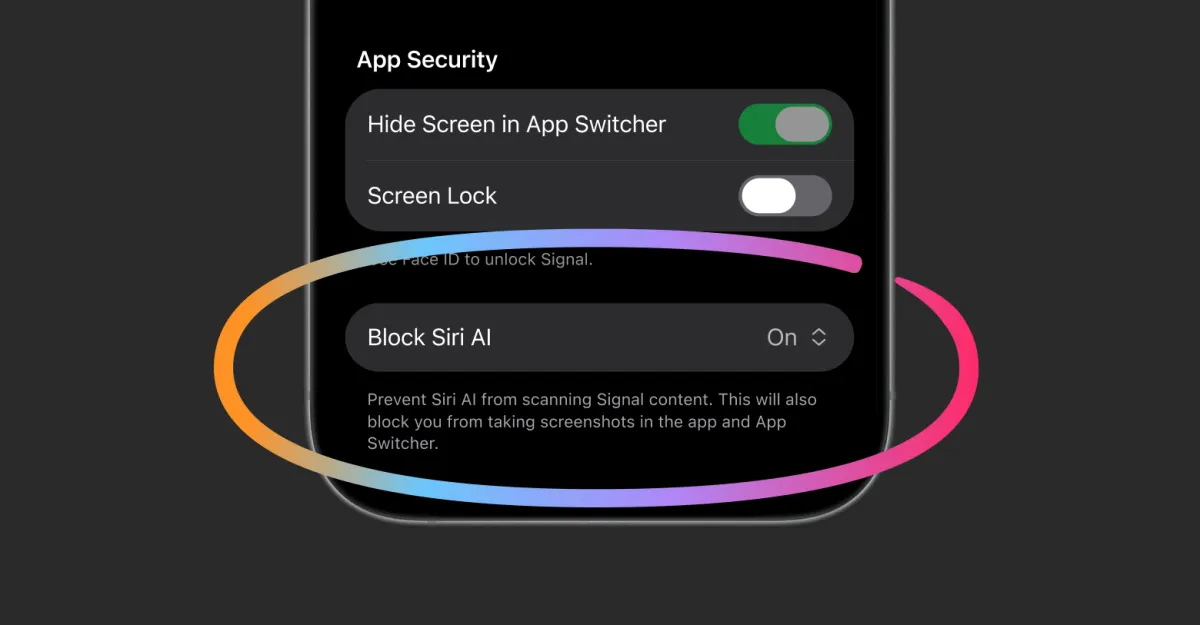
- Users can manually re-enable screenshots by turning off the 'Block Siri AI' toggle in Signal's privacy settings.
- This follows a previous measure against Microsoft's Recall AI on Windows 11, highlighting growing tensions between app developers and operating system providers over AI integration.
Privacy Measures Against AI Agents
Signal, the widely used encrypted messaging application, has implemented a significant privacy update that disables screenshot functionality on iOS and Android devices. This decision is a direct response to the increasing integration of agentic AI systems by major operating system developers, which the company argues poses an existential threat to user privacy. The update automatically blocks users from taking screenshots within the app, displaying a notification that reads, "Screenshot prevented by 'Block Siri AI' setting."
The core issue driving this change is the emergence of AI agents embedded directly into mobile operating systems. Apple has introduced Onscreen Awareness within Siri, while Google has integrated Gemini Intelligence into Android. These features allow the operating system to observe what is on a user's screen to provide context-aware assistance. Signal argues that these mechanisms effectively bypass the app's encryption and privacy controls, allowing external AI systems to access sensitive information.
The Scope of the Threat
Signal President Meredith Whittaker highlighted the severity of the situation in a blog post, explaining that sensitive data is being captured, stored, and made accessible to local databases or remote servers used by OS-level AI agents. Once this data is captured by the operating system, it falls outside of Signal's control, thereby imperiling the privacy of all participants in a conversation. Whittaker emphasized that the environment in which third-party developers operate is becoming increasingly hostile to privacy due to these deep integrations.
The update includes a specific toggle in Signal's privacy settings labeled "Block Siri AI." When enabled, which is the default state, this setting prevents Siri AI from scanning Signal content and also blocks screenshots in the app and the App Switcher. While the primary target is Apple's iOS ecosystem, Signal has also implemented similar restrictions on Android versions where it can detect an AI assistant attempting to read the screen. Notably, there is currently no equivalent feature for the Mac app.
User Control and Workarounds
Despite the strict default settings, Signal has provided users with a clear workaround. Individuals who wish to re-enable screenshot functionality can do so by visiting the app's privacy settings and turning off the "Block Siri AI" toggle. This ensures that while the default posture is protective, users retain control over their device's functionality if they choose to accept the potential privacy risks associated with AI agents.
This is not the first time Signal has had to take such drastic measures. Last year, the company disabled screenshots on Windows 11 to prevent Microsoft's Recall AI feature from capturing and storing screenshots of Signal messages. Microsoft's Recall AI was designed to create a searchable timeline of user activity, which raised significant privacy concerns when it was discovered that it could capture sensitive data from various applications, including secure messengers.
Broader Implications for the Tech Industry
Signal's actions underscore the growing tension between application developers and operating system providers as AI becomes more deeply integrated into consumer technology. The three major consumer operating systems—Windows, iOS, and Android—dictate the conditions under which third-party apps must operate. As these providers push for agentic AI capabilities that require screen access, developers like Signal are forced to implement countermeasures to protect their core mission of privacy.
Analysts note that this situation highlights a fundamental conflict in the tech industry. While OS providers view AI agents as a way to enhance user experience and functionality, developers argue that these features compromise the security and privacy guarantees that users expect from encrypted services. The situation is particularly acute because the AI agents operate at the system level, making it difficult for individual apps to prevent data extraction once the screen is active.
Key takeaways
- Signal has disabled screenshots on iOS and Android by default to prevent AI agents from accessing private chats.
- The move targets Apple's Siri Onscreen Awareness and Google's Gemini Intelligence, which scan screen content for context.
- Signal President Meredith Whittaker warns that OS-level AI agents capture data outside the app's control, threatening user privacy.
- Users can manually re-enable screenshots by disabling the 'Block Siri AI' toggle in the app's privacy settings.
- This follows a similar action against Microsoft's Recall AI on Windows 11, highlighting ongoing tensions over AI integration.
Sources
The WireByte editorial team synthesises technology news from multiple primary sources, verifies the facts, and links every source. Articles are produced with AI assistance and reviewed under our editorial policy.