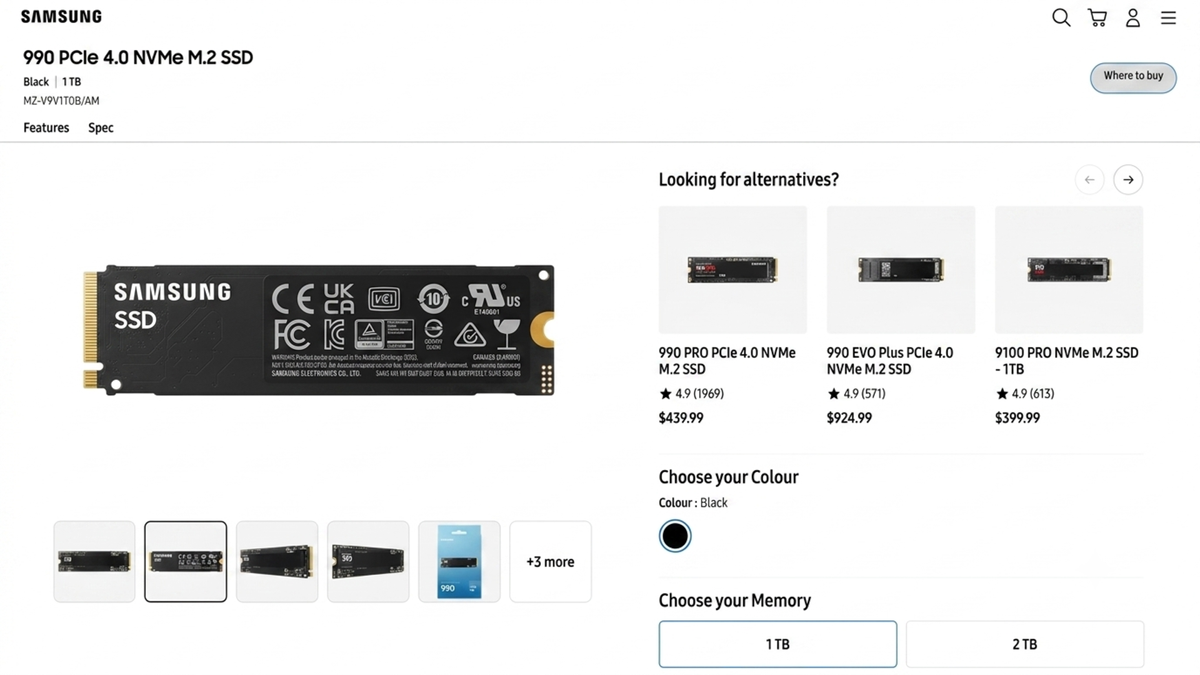
Samsung Launches Budget PCIe 4.0 SSD Without Onboard DRAM
Samsung has quietly prepared a budget PCIe 4.0 NVMe SSD that removes onboard DRAM, using NVMe's Host Memory Buffer feature to compensate for the gap. The 1TB drive offers sequential read speeds of 7,150 MB/s and write speeds of 6,450 MB/s. The move comes as the global 'RAMpocalypse' worsens, with vendors seeking to reduce dependence on DRAM. The unannounced model was listed on Samsung's website before being taken down without official confirmation.
Key points
- Samsung, the world's largest SSD vendor, has developed a budget PCIe 4.0 NVMe SSD without onboard DRAM.
- The 1TB drive offers sequential read speeds of 7,150 MB/s and write speeds of 6,450 MB/s.
- Samsung is using NVMe's Host Memory Buffer feature to compensate for the missing DRAM.
- The move is part of the industry's response to the global 'RAMpocalypse', which is worsening the shortage of DRAM.
- The unannounced model was listed on Samsung's website before being taken down without official confirmation.
Samsung's decision to remove onboard DRAM from its budget PCIe 4.0 NVMe SSD is a response to the global 'RAMpocalypse', a shortage of DRAM that is affecting the entire industry. By using NVMe's Host Memory Buffer feature, Samsung is able to compensate for the missing DRAM and still offer high-performance storage.
The 1TB drive, which was listed on Samsung's website before being taken down, offers sequential read speeds of 7,150 MB/s and write speeds of 6,450 MB/s. This is a significant improvement over traditional SSDs, which rely on dedicated DRAM to store the flash translation layer.
The use of Host Memory Buffer is a clever workaround for the missing DRAM, but it remains to be seen how well it will perform in real-world applications. As the industry continues to grapple with the shortage of DRAM, it will be interesting to see how other vendors respond to the challenge.
Sources
The WireByte editorial team synthesises technology news from multiple primary sources, verifies the facts, and links every source. Articles are produced with AI assistance and reviewed under our editorial policy.