Mathematician Modernizes Logic Textbook with AI Coding Agents
Terence Tao has utilized modern coding agents to rebuild 'QED', a 2018 interactive textbook on propositional and first-order logic. The new version, 'Lean Grimoire', integrates Lean proof verification and fantasy-themed gameplay modes. Tao is currently seeking playtesters to refine the tool as an educational resource for teaching logical proofs.
Key points
- Terence Tao, a renowned mathematician, has repurposed a 2018 interactive logic textbook titled 'QED' into a new application called 'Lean Grimoire'.
- The project leverages modern coding agents to rebuild the original JavaScript-based 'crafting game' that teaches propositional and first-order logic.
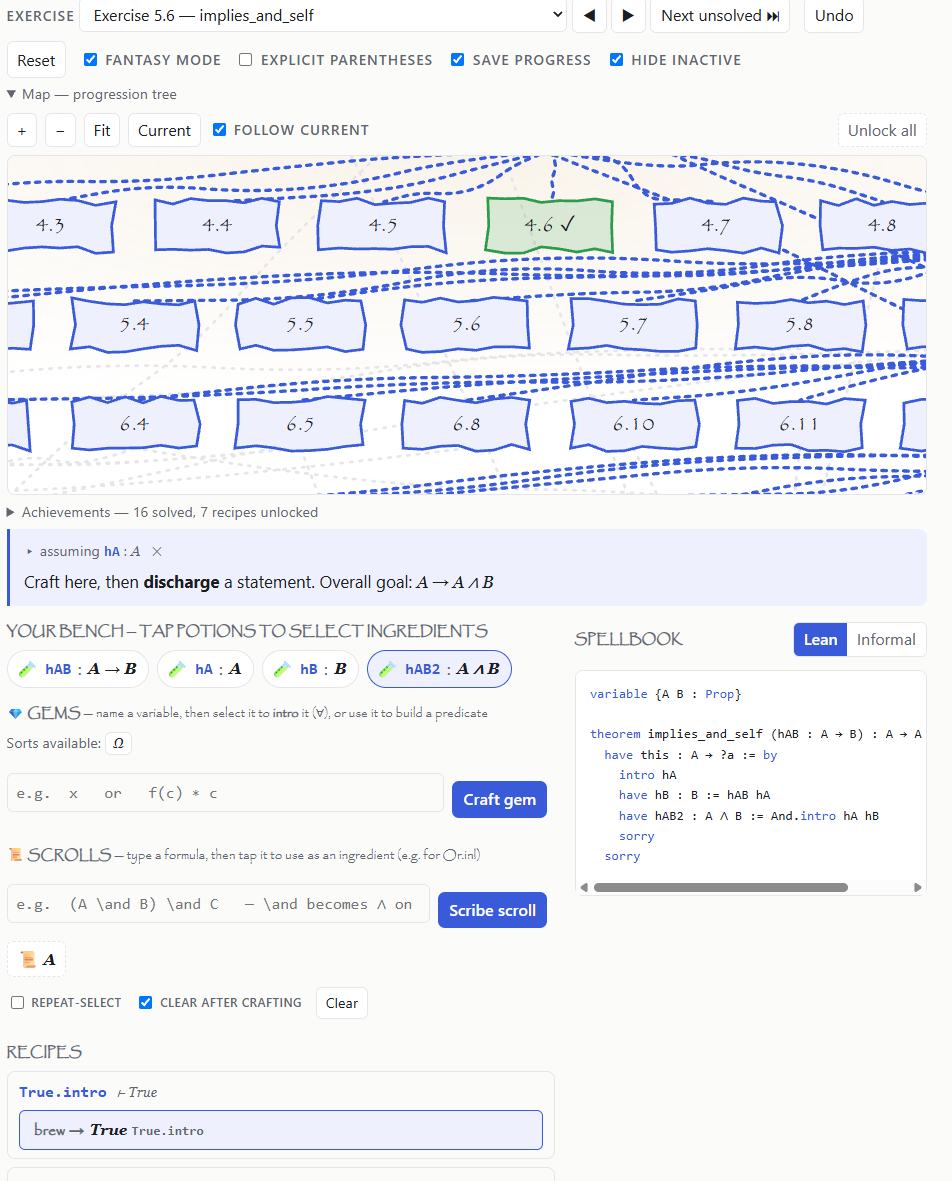
- New features include the ability to display in-progress Lean proofs alongside game states and a 'fantasy mode' that reimagines mathematical concepts as potions and scrolls.
- The application functions as an educational tool where users apply logical rules to derive conclusions from given hypotheses.
- Tao is actively inviting the public to participate in playtesting to help improve the app's effectiveness as a teaching aid for logic and Lean.
- The initiative highlights the growing role of AI-assisted development in modernizing educational software and interactive mathematical resources.
AI-Assisted Revival of Classic Logic Tool
Mathematician Terence Tao has announced the development of a new interactive educational application titled 'Lean Grimoire'. This project represents a modernization of a JavaScript-based interactive textbook Tao originally created in 2018, known as 'QED'. The initial version of the textbook was designed to teach the fundamentals of propositional and first-order logic through an engaging 'crafting game' format. In this original iteration, users were required to apply various rules of logic to reach a desired conclusion from a given set of hypotheses, effectively gamifying the process of mathematical proof construction.
Integration of Lean Proof Verification
The core innovation in 'Lean Grimoire' lies in its integration of modern coding agents to rebuild and enhance the original software. Tao utilized these AI-driven development tools to update the application, adding significant new features that bridge the gap between interactive learning and formal proof verification. A key addition is the option for users to view an in-progress Lean proof corresponding to their current game state. This feature allows learners to see how their logical steps translate into formal code, providing immediate feedback and reinforcing the connection between intuitive reasoning and rigorous mathematical formalism.
Fantasy Mode and Gamification
In addition to technical enhancements, the new application introduces creative gameplay elements to maintain user engagement. Tao added a 'fantasy mode' that reimagines the mathematical components of the game through a thematic lens. In this mode, mathematical statements are depicted as 'potions', while mathematical expressions are portrayed as 'scrolls'. This thematic layering aims to make the learning process more immersive and accessible, particularly for users who may find traditional mathematical notation intimidating. The visual and narrative elements serve to contextualize abstract logical concepts within a familiar fantasy framework.
Educational Objectives and Current Status
The primary objective of 'Lean Grimoire' is to serve as an effective tool for teaching logical proofs and the Lean proof assistant. Tao has stated that the application is designed to be more useful as a means to teach these complex subjects. The project was initially paused due to hectic events in the months following its conception in July, but recent availability of time has allowed for its completion and refinement. The application is currently in a stage where it is ready for external evaluation and feedback.
Call for Community Playtesting
Tao is actively seeking volunteers to participate in playtesting sessions for the application. The goal of this community involvement is to identify areas where the app can be improved as an educational resource. By gathering feedback from users, Tao aims to refine the interface and pedagogical approach to better suit learners of logic and Lean. This open approach to development underscores the collaborative nature of modern educational software projects, where user experience plays a critical role in shaping the final product.
Significance in Math Education
The development of 'Lean Grimoire' highlights the evolving landscape of mathematical education. By combining interactive gaming with formal proof verification, the application addresses the challenge of making abstract logical concepts tangible and engaging. The use of coding agents to rebuild the software also demonstrates the potential of AI in accelerating the development of educational tools. This project serves as a case study for how technology can be leveraged to enhance the teaching of foundational mathematical skills.
Key takeaways
- Terence Tao has rebuilt his 2018 logic textbook 'QED' into 'Lean Grimoire' using coding agents.
- The app teaches propositional and first-order logic through a crafting game format.
- Users can now view in-progress Lean proofs alongside their game actions.
- A 'fantasy mode' adds thematic elements like potions and scrolls to mathematical concepts.
- Tao is requesting playtesters to help refine the app as an educational tool.
- The project demonstrates the use of AI in modernizing interactive educational software.
Sources
The WireByte editorial team synthesises technology news from multiple primary sources, verifies the facts, and links every source. Articles are produced with AI assistance and reviewed under our editorial policy.