Explorative Modeling Boosts Generative Models by 36%
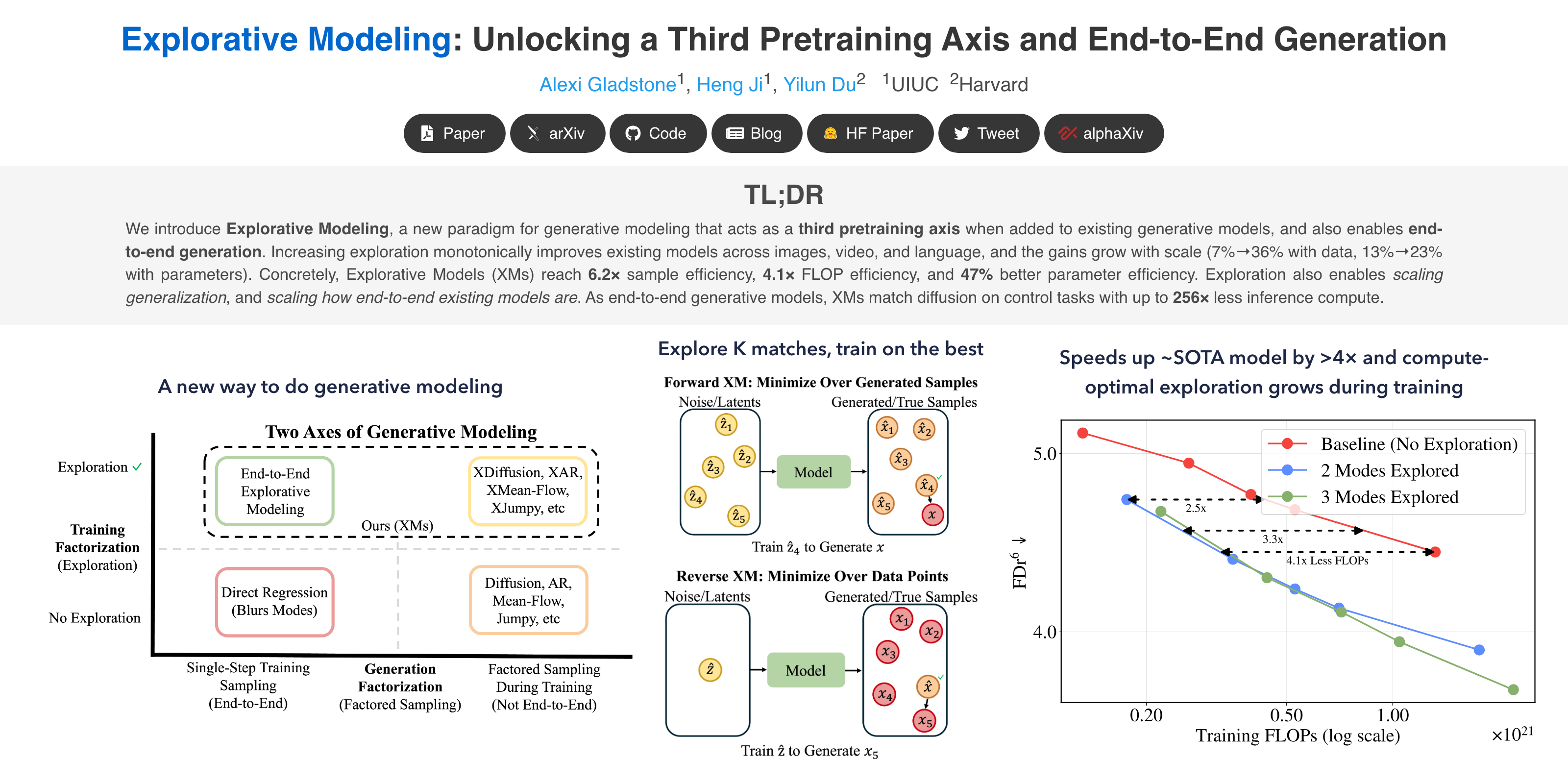
Researchers have introduced Explorative Modeling, a new paradigm for generative modeling that improves existing models across images, video, and language. The approach, developed by Alex Glad, increases exploration to achieve 6.2× sample efficiency, 4.1× FLOP efficiency, and 47% better parameter efficiency. This breakthrough has significant implications for AI applications, enabling scaling generalization and reducing inference compute.
Key points
- Alex Glad, the developer, introduced Explorative Modeling, a new paradigm for generative modeling that acts as a third pretraining axis.
- The approach improves existing models across images, video, and language, with gains growing with scale (7%→36% with data, 13%→23% with parameters).
- Explorative Models (XMs) achieve 6.2× sample efficiency, 4.1× FLOP efficiency, and 47% better parameter efficiency compared to existing models.
- The approach enables scaling generalization and reduces inference compute, with end-to-end generative models matching diffusion on control tasks with up to 256× less inference compute.
Explorative Modeling, a new paradigm for generative modeling, has been introduced by Alex Glad. This approach acts as a third pretraining axis when added to existing generative models, enabling end-to-end generation. The gains from Explorative Modeling are significant, with existing models improving across images, video, and language. The improvements grow with scale, with data-driven gains reaching 36% and parameter-driven gains reaching 23%.
The benefits of Explorative Modeling are multifaceted. It achieves 6.2× sample efficiency, 4.1× FLOP efficiency, and 47% better parameter efficiency compared to existing models. This means that Explorative Models can produce high-quality results while using fewer resources. Furthermore, the approach enables scaling generalization, allowing models to adapt to new tasks and environments more effectively.
In addition to these benefits, Explorative Modeling also reduces inference compute. End-to-end generative models, which are a key application of this approach, can match diffusion on control tasks with up to 256× less inference compute. This has significant implications for AI applications, where reducing inference compute can lead to faster and more efficient processing.
The potential applications of Explorative Modeling are vast. It can be used to improve existing models across a range of tasks, from image and video generation to language processing. By enabling scaling generalization and reducing inference compute, Explorative Modeling has the potential to revolutionize the field of AI and its applications.
Sources
The WireByte editorial team synthesises technology news from multiple primary sources, verifies the facts, and links every source. Articles are produced with AI assistance and reviewed under our editorial policy.