Apple Launches US Health AI Study with OpenEvidence to Test Trust and Safety
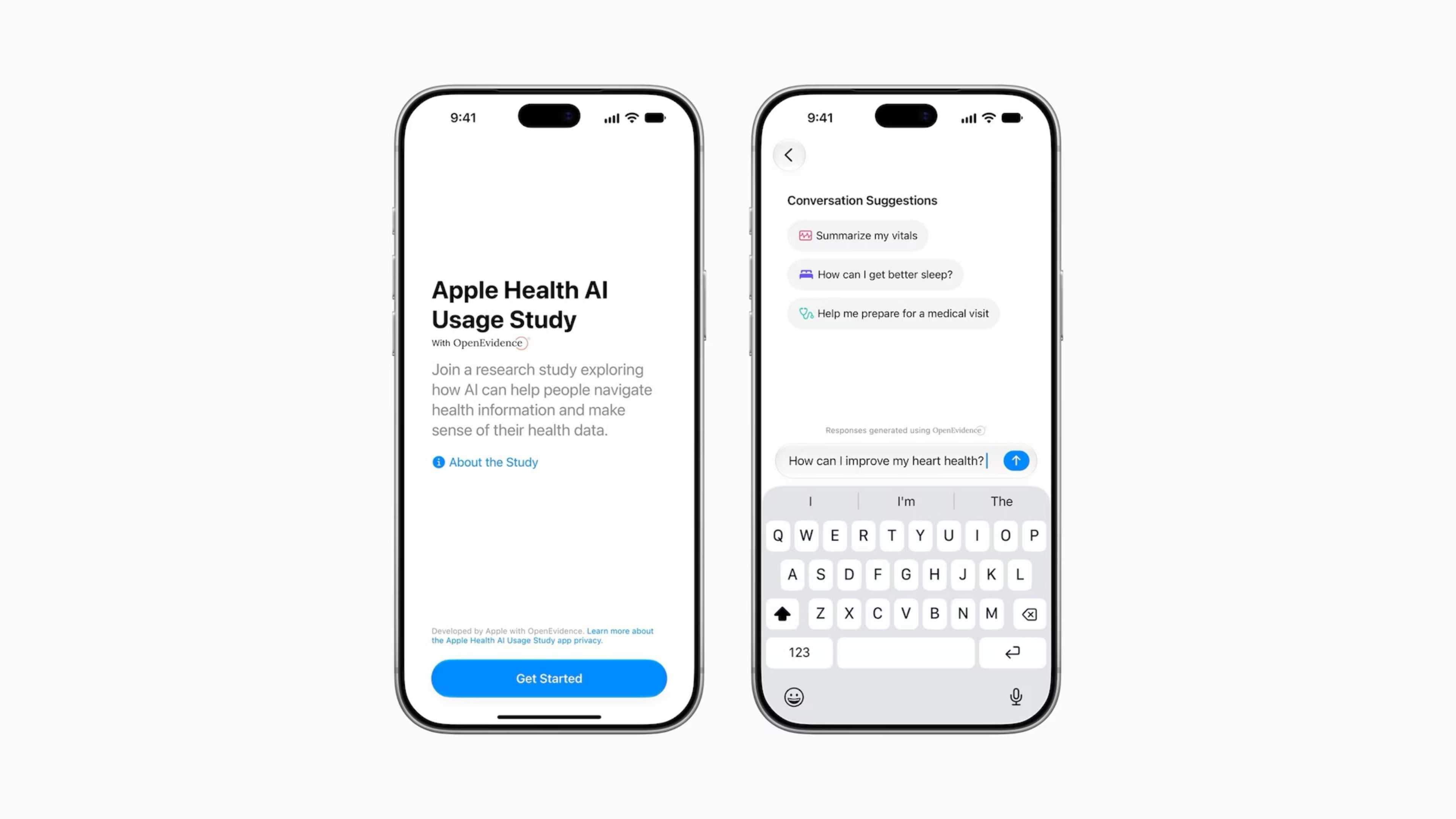
Apple has launched a U.S.-only research study, the Apple Health AI Usage Study, partnering with clinical AI platform OpenEvidence. The initiative seeks 200,000 participants to test trust in AI-generated health answers sourced from peer-reviewed journals. The study aims to determine how personal HealthKit data influences answer relevance and whether AI tools improve doctor visit preparation, addressing growing privacy and safety concerns in consumer health AI.
Key points
- Apple, in collaboration with clinical AI platform OpenEvidence, launched the Apple Health AI Usage Study to investigate public trust and comprehension of AI-generated health information.
- The U.S.-only study targets 200,000 participants who can use an iPhone app to ask health questions answered via peer-reviewed sources like The New England Journal of Medicine.
- Participants may optionally share HealthKit data, such as sleep or heart rate metrics, to test if personal health context improves the relevance and clarity of AI responses.
- Apple provides three key assurances: answers use authoritative medical sources, user data is not used for AI training, and no questions or answers are retained by the company.
- The study aims to determine if AI tools help users prepare for medical appointments and will inform future design of responsible health AI tools industry-wide.
- Sumbul Desai, Apple’s vice president of Health and Fitness, stated the research ensures scientific rigor and clinical grounding in how people engage with health AI in daily life.
Apple Enters Health AI Research with OpenEvidence Partnership
Apple has officially launched the Apple Health AI Usage Study, a significant research initiative designed to explore how consumers interact with artificial intelligence in the context of personal health. Conducted in collaboration with OpenEvidence, a clinical AI platform widely utilized by healthcare professionals, the study represents a strategic move by the tech giant to address growing concerns regarding the safety, privacy, and reliability of AI-generated medical information. The initiative is currently available exclusively to participants in the United States.
The core of the study involves a dedicated iPhone application that allows users to submit everyday health questions. Unlike general-purpose chatbots that may provide unverified or hallucinated information, this app generates responses using data drawn from rigorous, peer-reviewed clinical sources. These sources include prestigious publications such as The New England Journal of Medicine, the Journal of the American Medical Association (JAMA), and Nature. The app is designed to translate complex medical data into plain language, making it accessible to the general public while providing links to the original citations for transparency.
A critical component of the study is the optional integration of personal health data. Participants can choose to share information from their Apple Health app, known as HealthKit, which includes metrics such as resting heart rate, activity levels, sleep patterns, and lab results. Apple aims to analyze whether providing this personal context makes the AI-generated answers more relevant and easier to understand. This feature allows researchers to assess the value of personalized health data in enhancing the utility of AI tools for everyday decision-making.
Apple has emphasized strict privacy and ethical standards in the study’s design. The company offers three key assurances to participants that are not typically found in commercial AI chatbots. First, the answers are generated using authoritative medical sources rather than unvetted internet content. Second, the data provided by participants is not used to train Apple’s or OpenEvidence’s AI models. Third, the company does not retain any of the questions asked or the answers provided, ensuring that sensitive health queries remain private. These measures are intended to build trust in a sector where data privacy is a paramount concern.
Assessing Trust and Clinical Utility
The study seeks to answer fundamental questions about user behavior and trust. Researchers will measure how well participants understand the AI-generated answers, what factors influence their trust in the information, and what actions they take after receiving an answer. A specific focus is placed on whether the AI tool helps users better prepare for visits with their own doctors. By evaluating these outcomes, Apple hopes to determine if AI can serve as a effective preparatory tool for clinical consultations, potentially improving the efficiency and quality of patient-provider interactions.
Sumbul Desai, M.D., Apple’s vice president of Health and Fitness, highlighted the importance of scientific rigor in this endeavor. In a statement, Desai noted that responsible innovation in health technology requires clinical grounding. She explained that conducting a dedicated research study is the most thoughtful way to understand how people engage with, comprehend, and evaluate health AI in their daily lives. The insights gathered are intended to advance the broader scientific conversation and ensure that future health AI tools are trusted and genuinely supportive of users on their health journeys.
Impact on the Health AI Landscape
The launch of this study comes at a time when consumer use of AI chatbots for health-related queries is rapidly increasing. However, this trend has raised significant concerns among medical professionals and regulators regarding the potential for misinformation and privacy breaches. By positioning itself as a provider of a safe, clinically grounded alternative, Apple aims to differentiate its ecosystem from general-purpose AI platforms. The findings from this study could influence how the wider industry designs health AI tools, potentially setting new standards for accuracy, privacy, and user trust.
The study is part of Apple’s broader Research app ecosystem, which has been active since 2019. Previously, the app focused on allowing users to contribute anonymized health data to support academic and medical research. The Apple Health AI Usage Study expands this scope by incorporating interactive AI elements, marking a shift towards testing the utility of AI in real-world health scenarios. As the study progresses, it will provide valuable data on the intersection of consumer technology, clinical science, and artificial intelligence.
Key takeaways
- Apple launched the Apple Health AI Usage Study in the US with clinical AI partner OpenEvidence.
- The study seeks 200,000 participants to test trust in AI health answers sourced from peer-reviewed journals.
- Users can optionally share HealthKit data to see if personal context improves answer relevance.
- Apple guarantees that user data is not used for training and no queries are retained.
- The research aims to determine if AI tools help users prepare for doctor visits.
- Findings will inform the design of future responsible health AI tools industry-wide.
Sources
The WireByte editorial team synthesises technology news from multiple primary sources, verifies the facts, and links every source. Articles are produced with AI assistance and reviewed under our editorial policy.