Apple Launches Health AI Usage Study to Improve Medical Tool Design
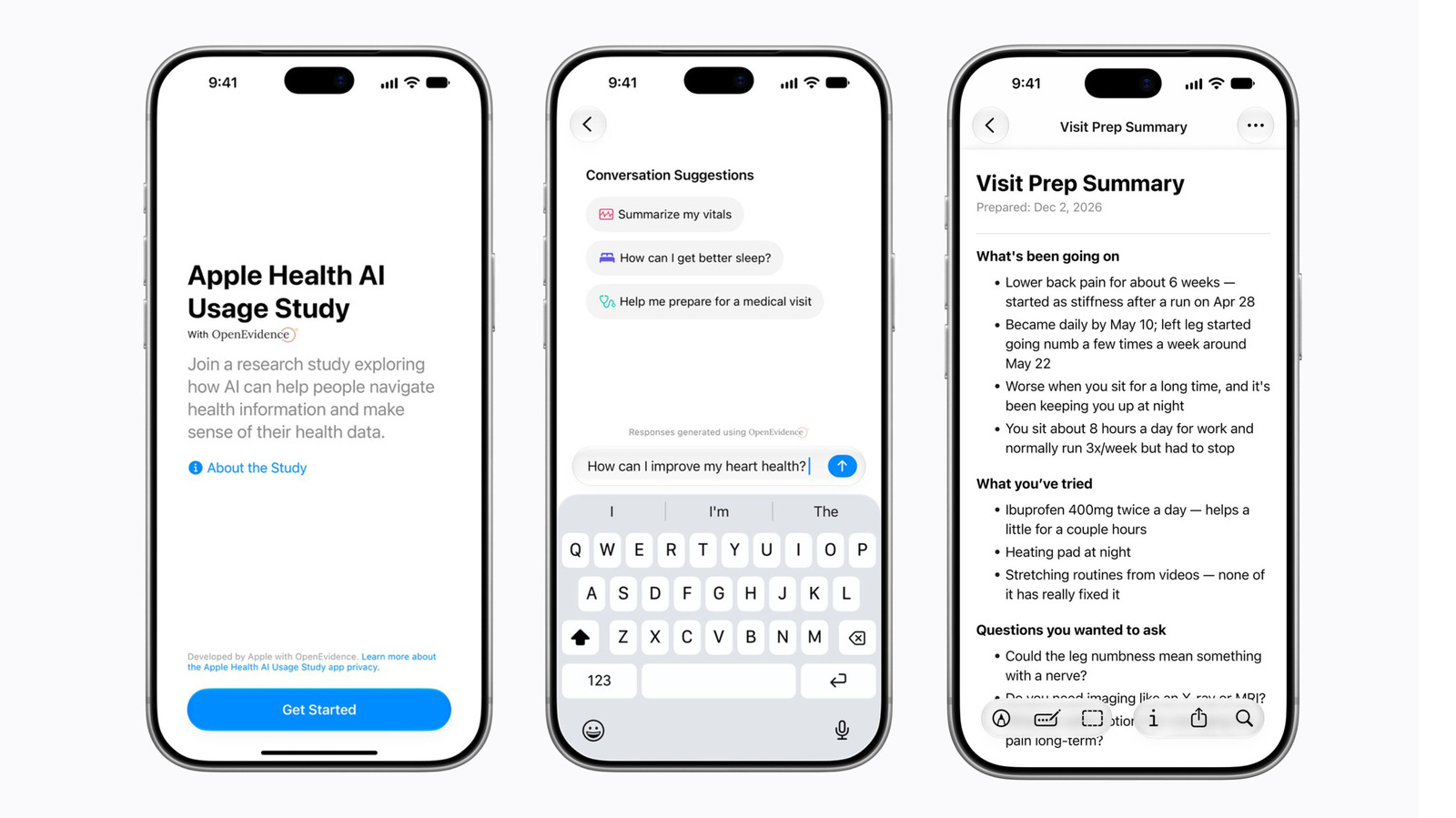
Apple, partnering with OpenEvidence, has launched a research app inviting up to 200,000 US-based iPhone users to test AI health tools. Participants aged 21+ on iOS 26+ will query medical questions and rate responses. The study aims to refine user-friendly health information without training AI models or integrating with Siri.
Key points
- Apple is collaborating with clinical AI platform OpenEvidence to launch the Health AI Usage Study.
- The research app targets up to 200,000 participants aged 21 or older residing in the US.
- Users must own an iPhone 15 Pro or later running iOS 26 or higher to participate.
- Participants can optionally share HealthKit data like sleep and activity levels for context.
- Apple states data will remain confidential and will not be used to train AI models.
- The initiative aims to make AI health tools more accessible and clinically grounded.
Apple Expands Health Research with New AI Study
Apple has officially unveiled a new research initiative designed to enhance the usability and effectiveness of artificial intelligence tools in the healthcare sector. Titled the Health AI Usage Study, the project represents a significant step in the company's ongoing efforts to integrate AI into health monitoring and information services. The study is being conducted in conjunction with OpenEvidence, a clinical AI platform widely utilized by healthcare professionals to access medical data from prestigious sources such as The New England Journal of Medicine. This partnership underscores Apple's strategy to ground its consumer-facing technologies in rigorous scientific and clinical standards.
Study Requirements and Participant Criteria
The research effort is accessible through a newly released application available for download on iOS devices. Apple has set ambitious participation goals, aiming to recruit up to 200,000 individuals for the study. To ensure data consistency and device compatibility, the company has established strict eligibility criteria. Participants must be at least 21 years of age and reside in the United States. Furthermore, they are required to use an iPhone 15 Pro or a later model operating on iOS 26 or a subsequent version. These hardware and software requirements ensure that the study captures data from devices capable of handling the latest interface and processing demands.
How the Application Functions
The core function of the research app involves interactive health queries. Users are encouraged to submit medical questions via text-based prompts, such as inquiries about improving heart health or understanding specific symptoms. In response, the application provides answers that are deliberately free of medical jargon, aiming to make complex health information accessible to the general public. Each response includes links to peer-reviewed clinical sources, allowing users to verify information and deepen their understanding. This design prioritizes clarity and actionable advice, addressing a common barrier in digital health where technical language can obscure useful guidance.
Integration of Health Data
A distinctive feature of the study is the optional integration of personal health metrics. Participants have the choice to share data from Apple HealthKit, which includes detailed information on activity levels, sleep quality, and laboratory results. This contextual data allows the AI to provide more personalized and relevant responses. For instance, a query about fatigue might be contextualized by recent sleep patterns. However, participation in sharing this data is entirely voluntary, respecting user privacy preferences while offering a richer dataset for researchers analyzing how personal health metrics influence AI interaction.
Privacy and Data Usage Guarantees
In an era where data privacy is a paramount concern, Apple has issued explicit assurances regarding the handling of participant information. The company has stated that the application is not integrated with Siri or Apple Intelligence services, isolating the study from other AI ecosystems. Crucially, Apple emphasized that participant data will remain confidential and will not be used to train AI models. This distinction is vital for maintaining user trust, as it separates observational research from the development of proprietary machine learning algorithms. The goal is to improve tool design through user feedback rather than harvesting data for model training.
Strategic Implications for Health Tech
The launch of the Health AI Usage Study reflects a broader industry shift toward making AI tools more intuitive and clinically reliable. By focusing on user experience and clarity, Apple aims to reduce the gap between advanced medical technology and everyday consumer understanding. The involvement of OpenEvidence adds a layer of clinical credibility, suggesting that the insights gained will be valuable for both consumer applications and professional medical tools. This study could set a precedent for how tech giants approach health-related AI, balancing innovation with rigorous ethical and scientific standards.
What Happens Next
As the study progresses, Apple will analyze the interactions and feedback from participants to refine its health AI tools. The insights gained are expected to inform future updates to health-related features, potentially influencing how AI is integrated into the broader Apple ecosystem. While the immediate focus is on usability, the long-term implications could extend to how health information is delivered across digital platforms. The success of this initiative may also encourage other technology companies to adopt similar research-driven approaches to health AI development.
Key takeaways
- Apple partners with OpenEvidence to launch the Health AI Usage Study.
- The study seeks up to 200,000 US-based participants aged 21 or older.
- Users must use an iPhone 15 Pro or later running iOS 26 or higher.
- The app provides non-jargon medical answers with links to peer-reviewed sources.
- Participants may optionally share HealthKit data for contextualized responses.
- Apple guarantees that data will not be used to train AI models.
Sources
The WireByte editorial team synthesises technology news from multiple primary sources, verifies the facts, and links every source. Articles are produced with AI assistance and reviewed under our editorial policy.