Apple Launches Health AI Study to Evaluate Clinical Chatbot Utility
Apple has launched the Apple Health AI Usage Study, partnering with OpenEvidence to assess how 200,000 U.S. users interact with clinical AI health tools. Running for over 12 months on iPhone 15 Pro devices, the study gathers feedback on accuracy and relevance of medical answers grounded in peer-reviewed journals, aiming to improve future AI health applications.
Key points
- Apple, in partnership with clinical AI platform OpenEvidence, has launched the Apple Health AI Usage Study to evaluate user interaction with health-focused chatbots.
- The study seeks up to 200,000 participants aged 21 and older in the United States to contribute data over a period of more than 12 months.
- Participants must use an iPhone 15 Pro running iOS 26 or later to access the dedicated app, which provides answers based on sources like The New England Journal of Medicine.
- Users can rate responses for accuracy, detail, and relevance, and optionally share HealthKit data such as sleep and lab results to receive personalized suggestions.
- The initiative aims to understand the effectiveness of clinically grounded AI in simplifying medical information and preparing users for doctor visits.
Apple Enters Clinical AI Research with New Study App
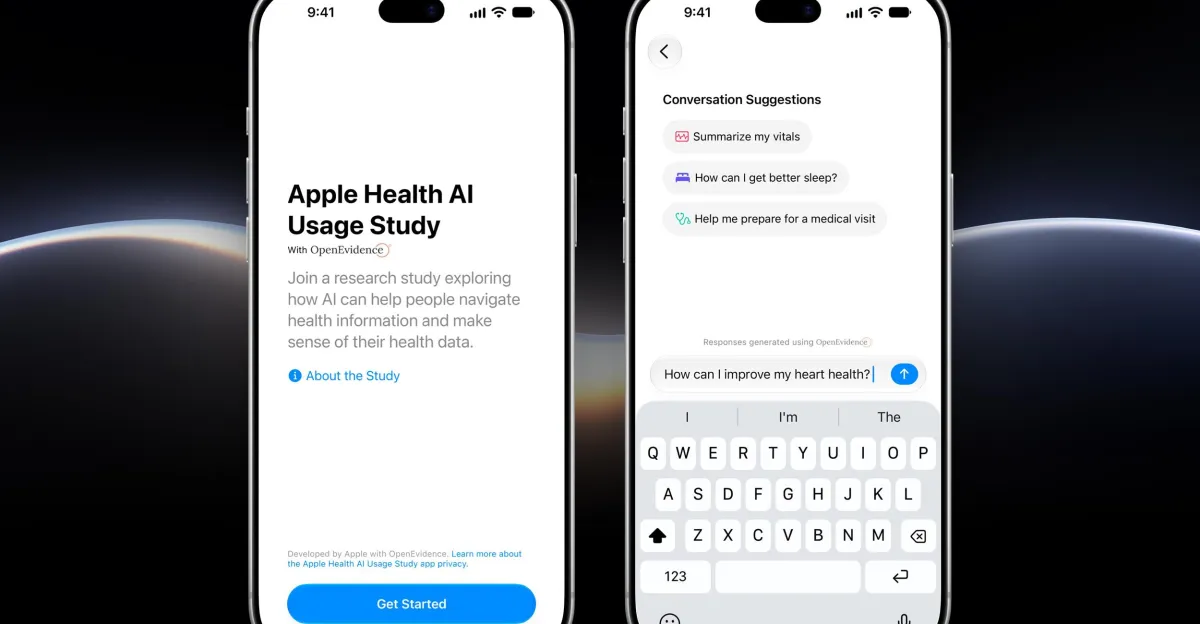
Apple has officially launched the Apple Health AI Usage Study, a significant initiative designed to understand how consumers interact with conversational artificial intelligence tools focused on health. In collaboration with OpenEvidence, a clinical AI platform utilized by healthcare professionals, Apple is deploying a new iOS application that allows users to ask medical questions and receive answers grounded in peer-reviewed clinical data. This move positions Apple within the growing sector of AI health applications, distinguishing its approach by prioritizing clinically verified sources over general chatbot responses.
The study is currently open for enrollment, with Apple targeting a maximum of 200,000 participants. To qualify, users must be at least 21 years of age and reside in the United States. The technical requirements are specific: participants must own an iPhone 15 Pro or later model and be running iOS 26 or later. While the app leverages the device's capabilities, it notably does not integrate with Siri or Apple Intelligence features, relying instead on text-based prompts and optional dictation via the iOS keyboard for user input.
How the Study Operates
The core function of the study app is to provide easily understandable responses to everyday medical questions. The underlying technology is powered by OpenEvidence, which generates answers by referencing high-quality medical literature, including publications such as The New England Journal of Medicine, the Journal of the American Medical Association, and Nature. This approach aims to bridge the gap between complex clinical data and patient understanding, offering simplified explanations that users can trust.
Participants are encouraged to actively engage with the tool by rating the AI-generated responses. The feedback mechanism focuses on three key criteria: accuracy, detail, and relevance. This user-generated data is crucial for Apple and OpenEvidence to assess the practical utility of clinical AI in real-world scenarios. Additionally, the app is designed to help users prepare for medical appointments by guiding them toward specific healthcare providers based on their queries.
Personalization Through HealthKit
A distinctive feature of the study is the optional integration with Apple HealthKit. Participants can choose to share personal health data, including resting heart rate, activity levels, sleep patterns, and clinical lab results. By incorporating this data, the app aims to provide more personalized and pointed suggestions, moving beyond generic advice to context-aware information. This integration allows the AI to tailor its responses to the individual’s health profile, enhancing the potential value of the interaction.
Long-Term Data Collection and Global Implications
The study is scheduled to run for more than 12 months, providing a long-term view of user engagement and satisfaction with clinical AI tools. Monthly surveys will be conducted to gather deeper insights into user experiences and perceptions. As AI models become increasingly prevalent in healthcare, understanding how laypeople interpret and rely on AI-generated medical information is critical. Apple’s decision to conduct this large-scale study highlights the industry's focus on safety, accuracy, and user trust.
The outcomes of the Apple Health AI Usage Study could influence the development of future health-focused AI features across the tech industry. By establishing benchmarks for accuracy and user satisfaction, Apple aims to set a standard for how clinical information is delivered through consumer devices. The study also raises important questions about data privacy and the ethical use of personal health information in AI training, areas that will likely remain under scrutiny as these tools become more common.
Key takeaways
- Apple and OpenEvidence are conducting a 12-month study with up to 200,000 U.S. participants to evaluate clinical AI health tools.
- Users must use an iPhone 15 Pro on iOS 26 or later to access the app, which sources answers from journals like The New England Journal of Medicine.
- Participants can rate AI responses for accuracy and relevance, and optionally share HealthKit data for personalized insights.
- The study aims to improve the effectiveness of AI in simplifying medical information and preparing patients for doctor visits.
- Apple’s initiative distinguishes itself by focusing on clinically grounded answers rather than general chatbot interactions.
Sources
The WireByte editorial team synthesises technology news from multiple primary sources, verifies the facts, and links every source. Articles are produced with AI assistance and reviewed under our editorial policy.