Anthropic Launches AI Office Suite to Challenge Microsoft and Google
Anthropic unveiled Claude Sheets, Meetings, and Whiteboards, expanding its AI assistant into a full office productivity suite. The tools, now in beta for paid users, allow Claude to join video calls and edit spreadsheets, directly competing with Microsoft and Google. This move targets knowledge workers, signaling a shift from coding assistance to broader enterprise applications as the company prepares for a Nasdaq listing.
Key points
- Anthropic, the AI safety-focused company backed by Amazon and Google, launched Claude Sheets, Meetings, and Whiteboards to expand beyond coding tools.
- Claude Meetings allows the AI to join video calls as a visible participant, taking real-time notes and drafting action items during the conversation.
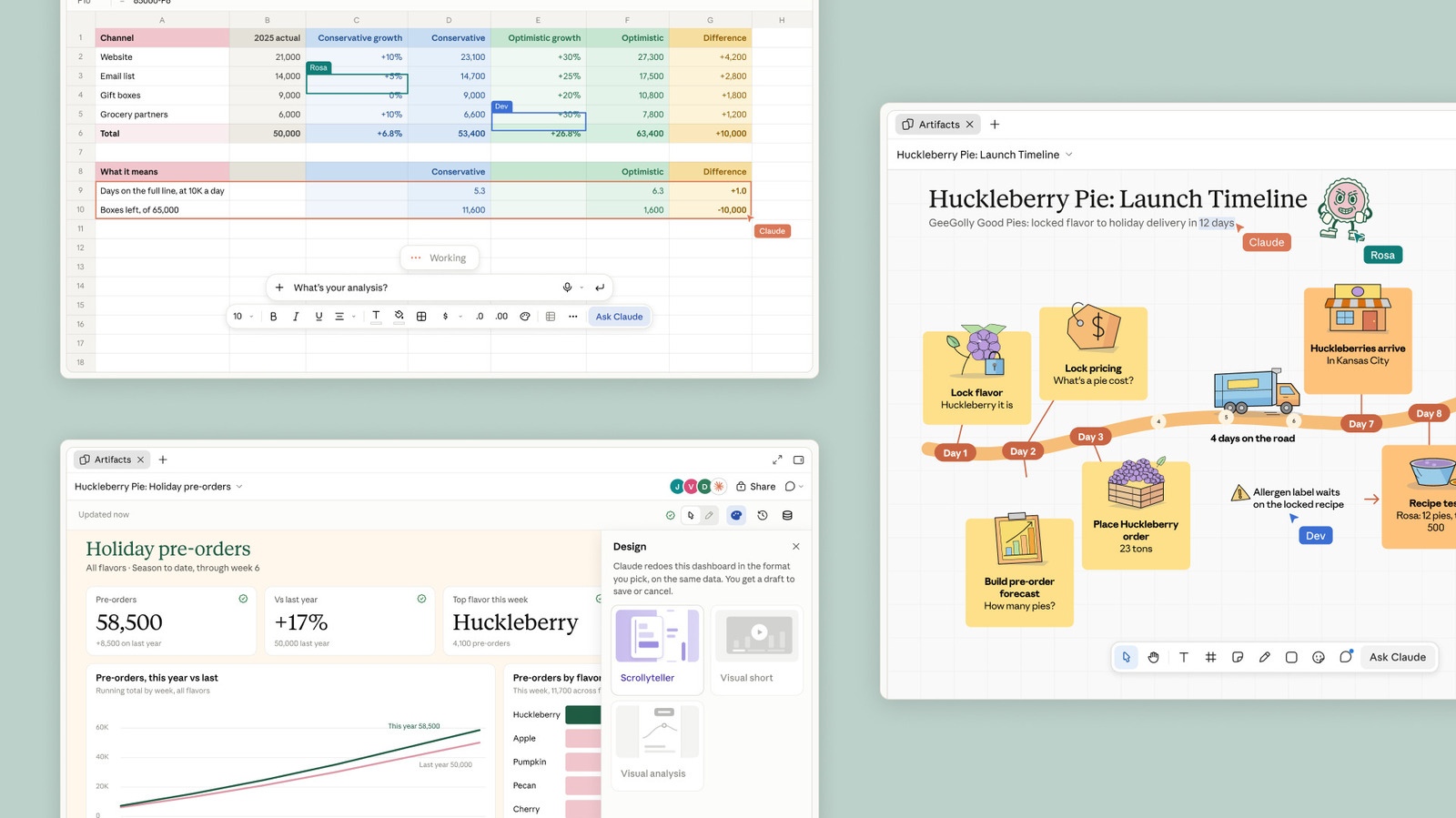
- Claude Sheets enables collaborative spreadsheet editing with formulas and tabs, exporting to Excel, while competing directly with Microsoft Excel and Google Sheets.
- The new tools are available in beta for paid subscribers, with Claude Data now generally available, targeting non-technical knowledge workers.
- Anthropic is integrating third-party apps like Adobe and Atlassian into Claude, aiming to replace or augment existing enterprise software workflows.
- The launch intensifies competition with Microsoft and Google, as Anthropic prepares for an anticipated Nasdaq listing later this year.
Anthropic Expands Into Productivity Software
Anthropic has significantly broadened the scope of its Claude AI assistant, unveiling a suite of new productivity tools designed to compete directly with the office software ecosystems of Microsoft and Google. During an event in San Francisco on Tuesday, the company introduced Claude Sheets, Claude Meetings, and Claude Whiteboards, marking a strategic pivot toward knowledge workers and enterprise applications. This expansion comes as the artificial intelligence sector intensifies its focus on workplace efficiency, with rivals like OpenAI and Meta also rolling out collaborative features.
The centerpiece of the announcement is Claude Meetings, a feature that allows the AI to join video calls as a visible participant. Rather than simply summarizing a meeting after the fact, Claude can listen in real-time, draft plans, map out timelines on a whiteboard, and answer questions in the meeting chat while the discussion is ongoing. The AI identifies itself as a participant and posts a notice in the meeting chat to inform attendees. Once the call ends, all generated materials, including notes and action items, are accessible on claude.ai. Initially, this feature is available for Google Meet users, though Anthropic has indicated support for other platforms may follow.
Alongside the meeting assistant, Anthropic launched Claude Sheets, a spreadsheet application that closely mirrors the functionality of Microsoft Excel and Google Sheets. The tool supports multiple tabs, formulas, and formatting options, allowing users to generate and edit data collaboratively. Changes made by Claude are tracked and visible to human editors, facilitating a hybrid workflow. Users can export their work to Excel, and the tool integrates with Anthropic’s existing Google Workspace plugin. Nicholas Lin, a product leader at Anthropic, described Sheets as "fairly basic" at launch, noting it is not intended for complex financial modeling but rather for simpler data tasks.
The company also introduced Claude Whiteboards, a digital canvas for brainstorming and visual planning, and expanded its Claude Data capabilities, formerly known as Claude Dashboards, which are now generally available to all paid plans. These tools join existing offerings like Claude Docs and Slides, which were released in September. The new "Artifacts" interface, which provides graphical user interfaces within the chat, has been updated to support these more complex, multi-step workflows.
Integration with Third-Party Ecosystems
A key component of Anthropic’s strategy is deep integration with existing enterprise software. The company announced that it is enabling third-party applications from Adobe, Atlassian, and HubSpot to run directly inside Claude. This move allows users to access versions of these popular business tools without leaving the Claude interface. This approach mirrors the strategy employed by Canva, which integrated with Claude in April. By embedding these apps, Anthropic aims to position Claude as a central hub for work, potentially reducing the need for employees to switch between multiple applications.
The launch of these tools places Anthropic in direct competition with Microsoft and Google, both of which are major backers of the company. While Anthropic has historically focused on enterprise clients and developer tools, such as Claude Code, this new suite targets a broader audience of non-technical knowledge workers. The company argues that the frontier of AI work is shifting from code generation to general knowledge work, where employees handle emails, meetings, and data analysis.
Market Implications and Future Outlook
The announcement comes at a critical time for Anthropic, which is preparing for an initial public offering on the Nasdaq later this year. The company’s valuation has soared in recent months, driven by its reputation for safety and its partnerships with tech giants. However, the move into productivity software also raises concerns among investors in traditional software companies. Fears that AI agents could replace established software have previously caused volatility in the stocks of companies like Adobe and Atlassian.
Anthropic’s product leader, Nicholas Lin, acknowledged that Microsoft and Google products remain superior for advanced enterprise use cases. However, he expressed hope that Claude would demonstrate new ways of working that integrate AI more seamlessly into daily tasks. The company’s strategy appears to be one of integration rather than total replacement, aiming to augment existing workflows rather than force a complete overhaul of enterprise software stacks.
As the AI race accelerates, the ability to integrate seamlessly into existing workflows will likely be a key differentiator. OpenAI recently unveiled similar workplace tools, and Meta is developing its Muse AI agent for task completion. Anthropic’s launch of a comprehensive office suite suggests that the competition is no longer just about the underlying language model, but about which AI can best serve as a daily work companion.
Key takeaways
- Anthropic launched Claude Sheets, Meetings, and Whiteboards to target knowledge workers and compete with Microsoft and Google.
- Claude Meetings joins video calls as a participant, taking real-time notes and drafting action items during the conversation.
- Claude Sheets offers collaborative spreadsheet editing with Excel export capabilities, though it is not yet suited for complex financial modeling.
- Third-party apps from Adobe, Atlassian, and HubSpot can now run inside Claude, integrating the AI into existing enterprise workflows.
- The new tools are available in beta for paid subscribers, with Claude Data now generally available, as Anthropic prepares for a Nasdaq listing.
- The launch marks a strategic shift from developer-focused tools to broader productivity applications, intensifying competition in the AI office suite market.
Sources
The WireByte editorial team synthesises technology news from multiple primary sources, verifies the facts, and links every source. Articles are produced with AI assistance and reviewed under our editorial policy.