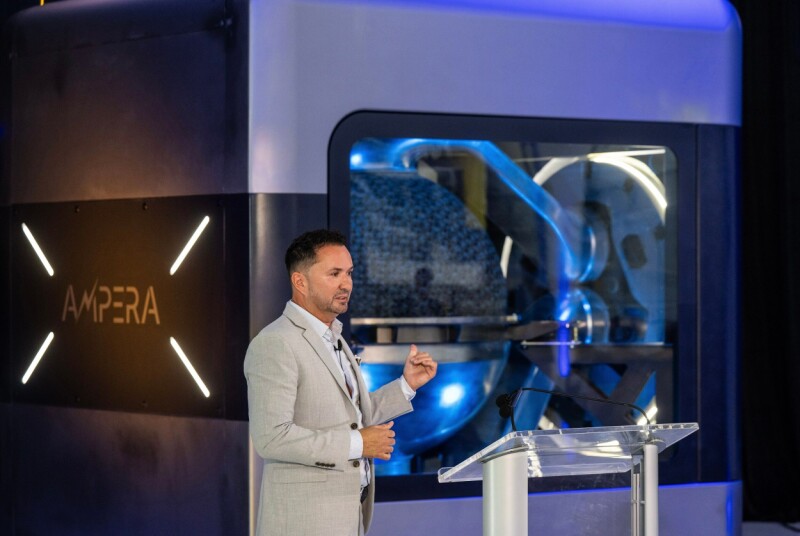
Ampera Unveils 3D-Printed Nuclear Reactor Module
US startup Ampera has developed the world's first 3D-printed nuclear reactor module, aiming to deliver emission-free power for datacenters, defense, and off-grid sites. The prototype features a fully 3D-printed silicon carbide reactor core and pressure vessel. Ampera's subcritical, solid-state thorium-based reactor is designed for factory-built, mass-produced nuclear energy.
Key points
- Ampera, a US startup, has produced the world's first 3D-printed nuclear reactor module at its innovation center in Palm Beach Gardens, Florida.
- The module features a fully 3D-printed silicon carbide reactor core and pressure vessel, marking a significant advancement in nuclear technology.
- Ampera's subcritical, solid-state thorium-based reactor is designed for factory-built, mass-produced nuclear energy, reducing emissions and increasing efficiency.
- The company's CEO, Brian Matthews, believes this technology will accelerate the commercialization of new nuclear technology, citing its potential for datacenters, defense, and off-grid sites.
- The reactor uses tristructural isotropic (TRISO) particles, consisting of a fuel kernel containing thorium, surrounded by multiple ceramic and carbon layers, which are not fissile.
Ampera Unveils 3D-Printed Nuclear Reactor Module
US startup Ampera has made a significant breakthrough in nuclear technology by developing the world's first 3D-printed nuclear reactor module. The company's innovation center in Palm Beach Gardens, Florida, hosted an event where the prototype was unveiled. Over 100 people attended, including local officials, business leaders, and employees.
The 3D-printed nuclear reactor module features a fully 3D-printed silicon carbide reactor core and pressure vessel. This advancement marks a significant step towards the development of factory-built, mass-produced nuclear energy. Ampera's subcritical, solid-state thorium-based reactor is designed to reduce emissions and increase efficiency.
According to Ampera's CEO, Brian Matthews, this technology has the potential to accelerate the commercialization of new nuclear technology. The company is working towards delivering scalable, emission-free power for datacenters, defense applications, and off-grid sites. The reactor uses tristructural isotropic (TRISO) particles, consisting of a fuel kernel containing thorium, surrounded by multiple ceramic and carbon layers, which are not fissile.
This breakthrough has the potential to revolutionize the nuclear industry, providing a cleaner and more efficient source of energy. As Ampera continues to develop this technology, it will be interesting to see how it is received by the market and regulatory bodies.
Sources
The WireByte editorial team synthesises technology news from multiple primary sources, verifies the facts, and links every source. Articles are produced with AI assistance and reviewed under our editorial policy.