WireByte
  • Log In
  • Sign Up
  • AI & Machine Learning
  • Technology
  • Science
  • Space & Astronomy
  • Gaming & Esports

Welcome Back

Log in to your WireByte account

Don't have an account? Sign Up

Create Account

Join WireByte for a personalized experience

Select your favorite categories:

Already have an account? Log In

Stay in the Loop

Get the stories that matter, delivered to your inbox.

You're all set! Check your inbox for a welcome email.

What do you want alerts for?

Search
Trending
WireByte
AI & Machine LearningTechnologyScienceSpace & AstronomyGaming & Esports

Home / Space & Astronomy

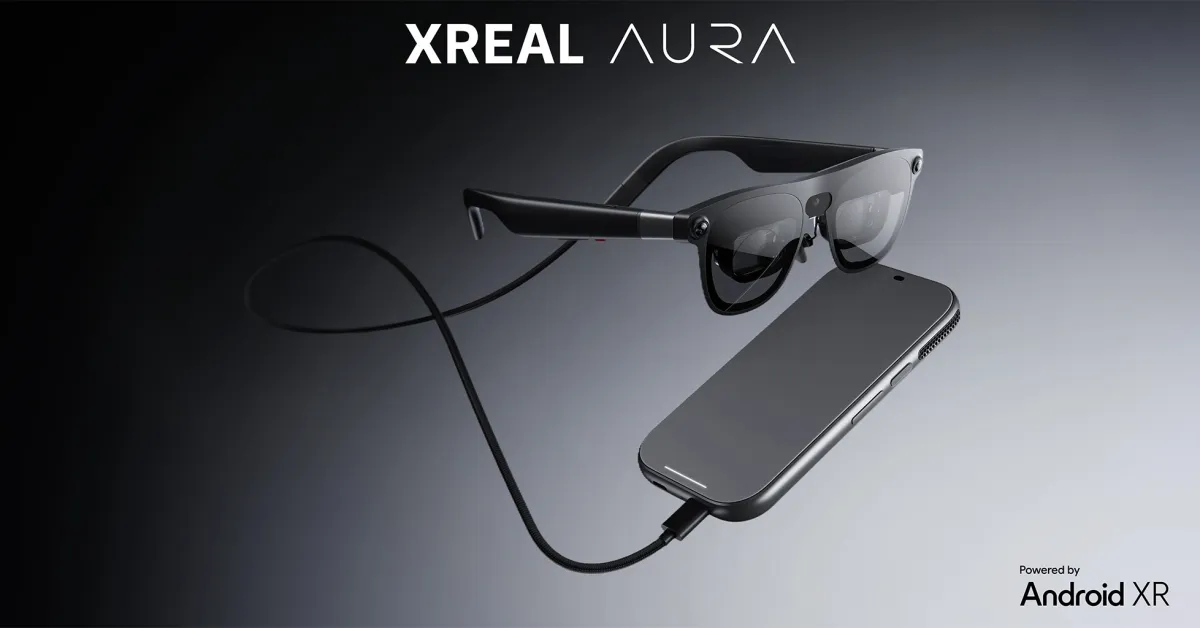
XREAL Aura Android XR Glasses Launch at Discounted Price
Image: © 9to5Google
Space & Astronomy

XREAL Aura Android XR Glasses Launch at Discounted Price

WireByte Staff · October 28, 2026

XREAL and Google have launched the XREAL Aura, the first smart glasses powered by the Android XR operating system. Priced at $1,099 for the base model through year-end, the device features a tethered compute puck, 150 native XR experiences, and Gemini integration. Shipping begins in mid-November across four initial markets, marking a significant entry into the spatial computing sector.

Key points

  • XREAL, in partnership with Google and Qualcomm, has officially launched the XREAL Aura, the first smart glasses to run the Android XR operating system.
  • The device features a lightweight 95-gram frame tethered to an external compute puck housing the Snapdragon Reality Elite chip, USB-C connectivity, and integrated Gemini AI.
  • The base 12GB/256GB model is available for $1,099 through December 2026, a $200 discount from the initial preorder price, while the 16GB/512GB model is priced at $1,299.
  • The glasses come preloaded with over 150 made-for-XR experiences, including titles like Fallout: Factions, the NBA App, and Project Hail Mary, alongside full Android app compatibility.
  • Initial availability is restricted to the United States, Canada, Japan, and South Korea, with broader global rollout expected in 2027.
  • The launch positions XREAL as a direct competitor to Meta’s smart glasses, leveraging Google’s ecosystem to offer a transparent display with a 95-degree field of view.

XREAL and Google Unveil Android XR Glasses

XREAL has officially launched the XREAL Aura, marking a significant milestone as the first smart glasses to operate on the Android XR platform. Developed in collaboration with Google and Qualcomm, the device was unveiled at Google’s Android Developer Summit, signaling a major push into the spatial computing market. The glasses represent a shift from standalone VR headsets toward lightweight, transparent displays that overlay digital content onto the real world, running on the co-developed Android XR operating system powered by Qualcomm’s Snapdragon Reality Elite chip.

Pricing and Availability Details

The XREAL Aura is now available for preorder, with shipments scheduled to begin in mid-November. The device is offered in two configurations: the XREAL AURA 12GB + 256GB model and the XREAL AURA 16GB + 512GB model. While the initial preorder price for the base model was $1,279, XREAL has announced a limited-time launch discount of $200, bringing the price down to $1,099. This discounted rate is valid through December 2026. The higher-tier model with 16GB of RAM and 512GB of storage is priced at $1,499, reduced to $1,299 under the same promotion. Both SKUs are available in standard and large sizes and include a carrying case that houses the glasses, the compute puck, and the USB-C cable. The cable is user-replaceable, designed to extend the device's longevity. Initial availability is limited to the United States, Canada, Japan, and South Korea, with a broader global rollout planned for 2027.

Hardware and Design Specifications

The XREAL Aura features a lightweight design weighing 95 grams, which is slightly heavier than Meta’s smart glasses at 69 grams but significantly lighter than traditional VR headsets like the Apple Vision Pro. The glasses utilize Sony’s Micro-OLED display technology, offering a 1200p resolution at 120Hz and a 95-degree field of view. A key design element is the tethered compute puck, which clips to the user's waistband. This external device handles processing power and battery life, featuring a built-in trackpad and fingerprint sensor. The glasses connect to the puck via a standard USB-C cable, allowing for compatibility with laptops and smartphones. The display is transparent, enabling users to interact with digital content while remaining aware of their physical surroundings.

Software Ecosystem and XR Experiences

Running on Android XR, the XREAL Aura integrates Google’s Gemini AI assistant directly into the operating system. The device supports all standard Android apps, allowing users to open applications directly on the glasses, arrange multiple virtual windows, and mirror laptop displays via USB-C. At launch, the platform includes over 150 made-for-XR experiences designed to showcase the spatial computing capabilities. Notable titles include Fallout: Factions, a strategy game developed with GameSir, which includes a dedicated Gemini key on the accompanying controller. Other featured experiences include the NBA App, which transforms surfaces into interactive basketball courts, the NASCAR XR App, and immersive content from the San Francisco Ballet Company and Hulu. The ecosystem aims to provide a seamless blend of productivity and entertainment, leveraging the vast Android app library.

Market Context and Competition

The launch of the XREAL Aura occurs as major tech companies compete for dominance in the smart glasses sector. Meta has been aggressively expanding its presence with its own line of smart glasses, while Apple continues to refine its Vision Pro headset. Google’s strategy relies on a partner ecosystem, similar to its approach with Android smartphones, to bring XR devices to consumers. By partnering with XREAL, Google aims to establish Android XR as a standard for transparent, lightweight AR glasses. The discounted launch price of $1,099 positions the Aura competitively against Meta’s offerings, though it remains a premium product. XREAL’s focus on a tethered design allows for a lighter form factor compared to standalone headsets, appealing to users seeking all-day wearability. The company has stated that the device is intended for work, entertainment, gaming, and general AI-assisted tasks, targeting early adopters and tech enthusiasts in the initial markets.

Key takeaways

  • XREAL Aura is the first smart glasses powered by the Android XR operating system, developed with Google and Qualcomm.
  • The device features a 95-gram lightweight frame tethered to an external compute puck with Snapdragon Reality Elite processing.
  • Launch pricing offers a $200 discount, with the base model at $1,099 and the premium model at $1,299 through December 2026.
  • The glasses include over 150 native XR experiences, such as Fallout: Factions and the NBA App, alongside full Android app support.
  • Initial availability is limited to the US, Canada, Japan, and South Korea, with global expansion expected in 2027.
  • The product competes directly with Meta’s smart glasses, leveraging Google’s Gemini AI and Android ecosystem for spatial computing.

Sources

  • 9to5google.com
  • techcrunch.com
  • engadget.com
  • androidauthority.com
  • 9to5google.com
  • theverge.com
WireByte Staff — Editorial Team

The WireByte editorial team synthesises technology news from multiple primary sources, verifies the facts, and links every source. Articles are produced with AI assistance and reviewed under our editorial policy.
More in Space & Astronomy

Android Auto Voice Command Loop Affects Pixel and Galaxy Users

Android Auto Voice Command Loop Affects Pixel and Galaxy Users

Google is investigating a bug in Android Auto where voice commands for calls and message…

SpaceX and Qualcomm Announce Starlink Mobile US Rollout for 2027

SpaceX and Qualcomm Announce Starlink Mobile US Rollout for 2027

SpaceX and Qualcomm have confirmed that Starlink Mobile will begin deploying a nationwid…

Nothing to Launch Screenless AI Device in December

Nothing to Launch Screenless AI Device in December

Nothing CEO Carl Pei announced the company’s first AI-native hardware will launch in Dec…

space stars galaxy

SpaceX Partners with Qualcomm for Starlink Mobile 5G Network

SpaceX has selected Qualcomm to supply technology for its Starlink Mobile 5G service, ai…

Latest

Apple Targets 16M MacBook Neo Shipments in 2027

Apple Targets 16M MacBook Neo Shipments in 2027

Apple plans to double MacBook Neo shipments to 16 million units in 2027, signaling stron…

Nintendo Reports Switch 2 Sales Drop Amid Price Hike and Profit Shift

Nintendo Reports Switch 2 Sales Drop Amid Price Hike and Profit Shift

Nintendo reported a 37.4% drop in Switch 2 sales for the first half of fiscal 2026, sell…

Ninja Launches Luxe Café Mini and Jonathan Adler Collaboration Espresso Machines

Ninja Launches Luxe Café Mini and Jonathan Adler Collaboration Espresso Machines

Ninja has introduced the compact Luxe Café Mini, now priced at $399.99, and the high-end…

Amazon Replaces Grubhub with Uber Eats for Prime Delivery

Amazon Replaces Grubhub with Uber Eats for Prime Delivery

Amazon has ended its partnership with Grubhub and designated Uber Eats as the official r…

Sony Profits Surge on Spider-Man Box Office and PS5 Software Sales

Sony Profits Surge on Spider-Man Box Office and PS5 Software Sales

Sony reported a 44% profit increase to 449.6 billion yen, driven by Spider-Man: Brand Ne…

US Midterms: Tech Oligarchs Face Political Backlash as Democrats Retake Congress

US Midterms: Tech Oligarchs Face Political Backlash as Democrats Retake Congress

Democrats have retaken control of the US Congress following the midterm elections, signa…

Related articles

Android Auto Voice Command Loop Affects Pixel and Galaxy Users Space & Astronomy Android Auto Voice Command Loop Affects Pixel and Galaxy Users WireByte

Google is investigating a bug in Android Auto where voice commands for calls and messages trigger an endless loop, repeatedly asking 'Who do you want to call?' despite recognizing the contact. The issue impacts Pixel 10 and Samsung Galaxy devices, coinciding with wider Gemini integration. No fix is confirmed.

WireByte Staff · November 5, 2026

SpaceX and Qualcomm Announce Starlink Mobile US Rollout for 2027 Space & Astronomy SpaceX and Qualcomm Announce Starlink Mobile US Rollout for 2027 WireByte

SpaceX and Qualcomm have confirmed that Starlink Mobile will begin deploying a nationwide 5G cellular network in the United States starting in 2027. Utilizing DragonWing infrastructure, the venture aims to challenge major carriers by leveraging satellite spectrum and terrestrial base stations, marking a significant expansion into the US telecom market.

WireByte Staff · November 5, 2026

Nothing to Launch Screenless AI Device in December Space & Astronomy Nothing to Launch Screenless AI Device in December WireByte

Nothing CEO Carl Pei announced the company’s first AI-native hardware will launch in December. The device is screenless and described as a tool that 'couldn’t have been an app,' suggesting it is an ambient recorder or note-taking device designed to capture fleeting ideas without the friction of traditional smartphones.

WireByte Staff · November 4, 2026

space stars galaxy Space & Astronomy SpaceX Partners with Qualcomm for Starlink Mobile 5G Network WireByte

SpaceX has selected Qualcomm to supply technology for its Starlink Mobile 5G service, aiming for a nationwide US rollout by 2027. The multi-year agreement involves deploying tens of thousands of sites using Qualcomm’s Dragonwing platforms. This move positions SpaceX to compete directly with major carriers like AT&T and Verizon by combining ground infrastructure with its satellite constellation.

WireByte Staff · November 4, 2026

Apple Targets 16M MacBook Neo Shipments in 2027 Apple Apple Targets 16M MacBook Neo Shipments in 2027 WireByte

Apple plans to double MacBook Neo shipments to 16 million units in 2027, signaling strong demand for its entry-level laptop. The device, launched in March 2026 with an A18 Pro chip, saw a price increase to $699. Supply chain sources attribute recent Mac sales growth largely to the Neo model, with a second-generation version expected next year.

WireByte Staff · November 5, 2026

Nintendo Reports Switch 2 Sales Drop Amid Price Hike and Profit Shift Gaming & Esports Nintendo Reports Switch 2 Sales Drop Amid Price Hike and Profit Shift WireByte

Nintendo reported a 37.4% drop in Switch 2 sales for the first half of fiscal 2026, selling 6.49 million units. Operating profit fell 16% to 73.9 billion yen despite an 11% rise in net profit driven by software and movie revenue. The company ruled out further price increases, maintaining its 16.5 million unit annual forecast despite memory cost pressures.

WireByte Staff · November 5, 2026

WireByte

Tech & AI news, synthesised and to the point.

Delivering original syntheses and breaking news with cited sources. Stay informed with WireByte.

Sections

  • AI & Machine Learning
  • Technology
  • Science
  • Space & Astronomy
  • Gaming & Esports

Company

  • About Us
  • Editorial Policy
  • Privacy Policy

Newsletters

Get the stories that matter, delivered to your inbox.

© 2026 WireByte. All rights reserved. Original syntheses with cited sources.

Home Search