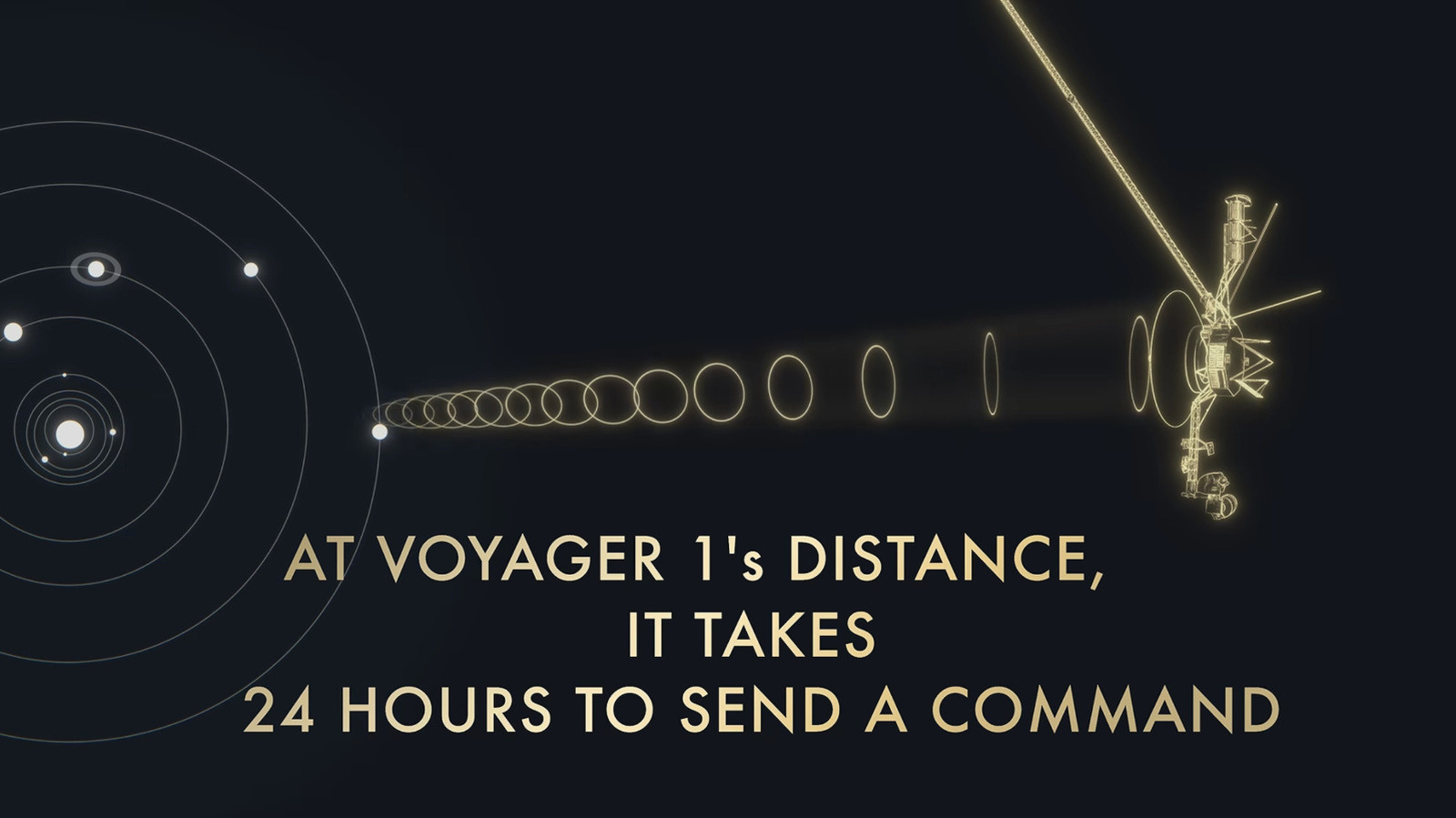
Voyager 1 Becomes First Human Object One Light-Day from Earth
NASA’s Voyager 1 probe has officially crossed the one-light-day milestone, placing it 16.094 billion miles from Earth. This unprecedented distance means radio signals now take 24 hours for round-trip communication. Launched in 1977, the still-operational spacecraft continues its journey through interstellar space toward the star Gliese 445.
Key points
- Voyager 1, launched by NASA in 1977, became the first human-made object to reach a distance of one light-day from Earth.
- The spacecraft crossed the 16.094 billion-mile milestone at 5:16 AM Eastern Time on November 18, following a 49-year journey.
- Due to the speed of light, communication with the probe now requires 24 hours for a signal to travel to Earth and for a response to return.
- Mission manager Kareem Badaruddin described the achievement as extraordinary, noting it is a unique event that may never happen again.
- Voyager 1 is heading toward the star Gliese 445 in the Ursa Minor constellation, a journey that will take approximately 40,000 years to complete.
A Milestone in Interstellar Travel
NASA’s Voyager 1 spacecraft has achieved a historic distance milestone, officially becoming the first human-made object to travel one light-day away from Earth. This extraordinary achievement marks a significant point in the probe’s ongoing journey through the void of space, highlighting the enduring capability of human engineering to reach the farthest reaches of the cosmos. The milestone underscores the vast scale of interstellar space and the unique position Voyager 1 now occupies as the most distant artifact from our planet.
The spacecraft crossed the one-light-day threshold at 5:16 AM Eastern Time on November 18. At this precise moment, Voyager 1 was approximately 16.094 billion miles from Earth. This distance is defined as the space light travels in 24 hours. Because radio signals, which carry data between Earth and the probe, travel at the speed of light, the communication delay is now exactly one day. It takes 24 hours for a command to reach the spacecraft and another 24 hours for the confirmation to return. Consequently, NASA will not be able to confirm the exact timing of the milestone until the probe’s message arrives the following day.
Operational Resilience After Decades
Launched in 1977, Voyager 1 was part of a program designed to study the outer planets and eventually interstellar space. It was launched 16 days after its twin, Voyager 2, but has since surpassed its sibling in distance. Voyager 1 entered interstellar space in 2012, becoming the first human-made object to do so. Despite its age, the probe remains operational, a testament to NASA’s engineering and maintenance efforts. The spacecraft continues to send back valuable data on plasma waves, magnetic fields, and space-bound particles, providing scientists with unique insights into the environment beyond our solar system.
The probe has faced significant challenges over its 49-year journey. Technical glitches have required NASA to shut down certain features to conserve power, particularly as the plutonium in its radioisotope thermoelectric generators diminishes. Despite these constraints, Voyager 1 continues to function, traveling at nearly 38,000 miles per hour. Its longevity and continued operation are considered remarkable feats, especially given the harsh conditions of interstellar space and the limitations of its power source.
Future Trajectory and Global Significance
Voyager 1 is currently heading toward the star Gliese 445 in the Ursa Minor constellation. This star is located 17 light-years away from Earth. At its current speed, Voyager 1 will not pass by Gliese 445 for approximately 40,000 years. This long-term trajectory highlights the probe’s role as a time capsule and a marker of human presence in the galaxy. The mission’s primary objectives, including flybys of Jupiter and Saturn, were completed in 1980, but the extended mission has provided decades of scientific data.
The significance of this milestone extends beyond scientific data. It represents a unique moment in history, as described by Voyager mission manager Kareem Badaruddin. He noted that the achievement is extraordinary and may never happen again. This sentiment reflects the singular nature of Voyager 1’s journey and its status as the most distant human-made object. The probe’s continued operation and communication, despite the vast distance, demonstrate the resilience of space exploration technology.
Voyager 2, which launched 16 days before Voyager 1, is also expected to reach a distance of one light-day from Earth. However, this milestone is not expected until 2035. This timeline highlights the different trajectories and speeds of the two probes. Voyager 1’s faster speed and earlier entry into interstellar space have allowed it to reach this milestone decades ahead of its twin.
Key takeaways
- Voyager 1 became the first human-made object to reach one light-day from Earth on November 18.
- The spacecraft is now 16.094 billion miles away, causing a 24-hour communication delay.
- Launched in 1977, Voyager 1 remains operational and continues to send scientific data.
- The probe is traveling toward the star Gliese 445, a journey taking 40,000 years.
- Mission manager Kareem Badaruddin described the milestone as an extraordinary, unique event.
Sources
The WireByte editorial team synthesises technology news from multiple primary sources, verifies the facts, and links every source. Articles are produced with AI assistance and reviewed under our editorial policy.