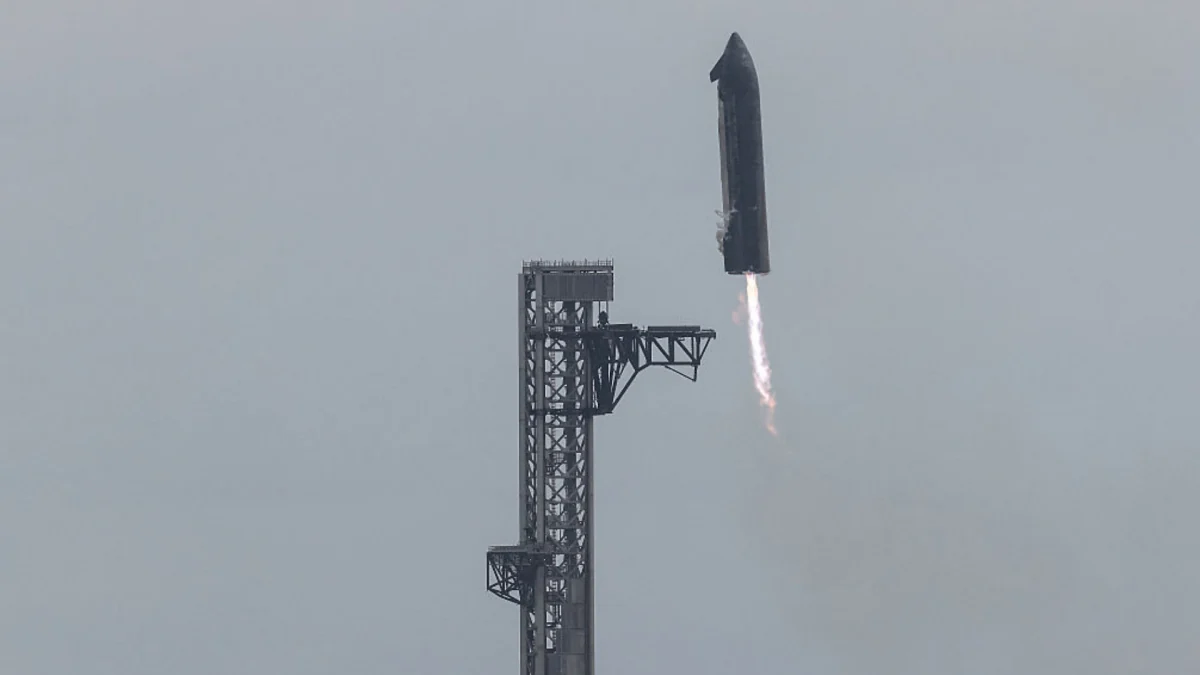
SpaceX Successfully Catches Starship for First Time in Historic Launch
SpaceX achieved a major milestone by catching its Starship rocket with mechanical arms after launch from Texas. The 400-foot vehicle deployed 26 Starlink satellites during a 22.5-hour mission. This marks the first successful catch of the upper stage, proving reusable launch technology and advancing interplanetary capabilities.
Key points
- SpaceX, the aerospace company founded by Elon Musk, successfully caught its Starship upper stage with mechanical arms for the first time.
- The launch occurred at the Starbase facility in Boca Chica, Texas, featuring a rocket over 400 feet tall and weighing more than 5,000 tons.
- The mission lasted 22.5 hours, during which the vehicle orbited Earth 14 times and deployed 26 Starlink V3 satellites.
- Elon Musk shared point-of-view footage from the launch tower on X, highlighting the engineering feat of the catch.
- While the Super Heavy booster had been caught three times previously, this event marks the first successful capture of the actual Starship vessel.
- The achievement validates reusable rocket technology, a critical step for reducing costs and enabling future interplanetary missions.
Historic Catch Achieved at Starbase
SpaceX has marked a significant milestone in aerospace engineering by successfully catching its Starship rocket with mechanical arms following a launch from its facility in Boca Chica, Texas. The event, described by founder Elon Musk as a banner day for the quest for the stars, demonstrates the viability of reusable launch systems for the largest rocket ever built. The successful capture of the upper stage distinguishes this mission from previous attempts, where only the Super Heavy booster had been caught.
Mission Details and Specifications
The Starship vehicle, standing over 400 feet tall and weighing more than 5,000 tons, launched from the Starbase launchpad without incident. During its 22.5-hour mission, the spacecraft orbited the Earth 14 times. A primary objective of the flight was the deployment of 26 Starlink V3 satellites, which were successfully delivered into orbit. The mission's duration and orbital mechanics highlighted the vehicle's capability for long-duration space operations.
The Engineering Feat of the Catch
The central challenge of the mission was the landing phase, where SpaceX aimed to prove its reusable rocket theory. The team utilized well-timed rocket boosters and complex engineering to catch the falling Starship with giant mechanical arms. While the Super Heavy booster had been successfully caught on three prior occasions, this mission marked the first time the actual Starship upper stage was captured. This distinction is critical for the company's goal of fully reusable orbital launch vehicles.
Musk's Perspective and Public Reaction
Elon Musk took to X, the social media platform formerly known as Twitter, to share his point-of-view footage from atop the launch tower shortly after the catch. The video provided a unique perspective on the scale of the operation, which is often difficult to convey in traditional photographs due to the distance required for bystanders and journalists to remain at safe watch sites. The footage underscored the sheer size of the rocket and the precision of the mechanical arms.
Significance for Future Exploration
This achievement is viewed as a critical step in the history of human spaceflight. By demonstrating the ability to catch and presumably reuse the Starship vehicle, SpaceX is advancing its strategy for interplanetary travel. The reusable model is intended to drastically reduce the cost of access to space, enabling more frequent launches and supporting long-term goals such as missions to Mars. The success of this catch validates the engineering approach that underpins the company's ambitious expansion plans.
Context of Previous Attempts
Prior to this mission, SpaceX had attempted the catch mechanism multiple times. The Super Heavy booster, the first stage of the rocket, had been caught successfully on three occasions. However, catching the Starship upper stage presented a different set of challenges due to its trajectory and speed. The successful execution of this specific maneuver indicates a maturation of the company's landing and recovery technologies.
Global Impact on the Space Industry
The successful launch and catch have implications for the global space industry. As the largest interplanetary rocket in the SpaceX fleet, Starship's capabilities set a new benchmark for payload capacity and reusability. Competitors and international space agencies are closely monitoring these developments as the landscape of space exploration continues to evolve. The ability to rapidly reuse heavy-lift vehicles could reshape the economics of satellite deployment and deep-space missions.
Key takeaways
- SpaceX successfully caught the Starship upper stage with mechanical arms for the first time.
- The launch occurred at Starbase in Boca Chica, Texas, with a rocket over 400 feet tall.
- The mission deployed 26 Starlink V3 satellites after orbiting Earth 14 times over 22.5 hours.
- Elon Musk shared POV footage from the launch tower, highlighting the scale of the operation.
- This event marks the first successful catch of the Starship, distinct from previous Super Heavy booster catches.
- The achievement validates reusable rocket technology, crucial for reducing costs and enabling interplanetary travel.
Sources
The WireByte editorial team synthesises technology news from multiple primary sources, verifies the facts, and links every source. Articles are produced with AI assistance and reviewed under our editorial policy.