Security Researcher Rickrolls Prusa 3D Printer via Remote Code Execution
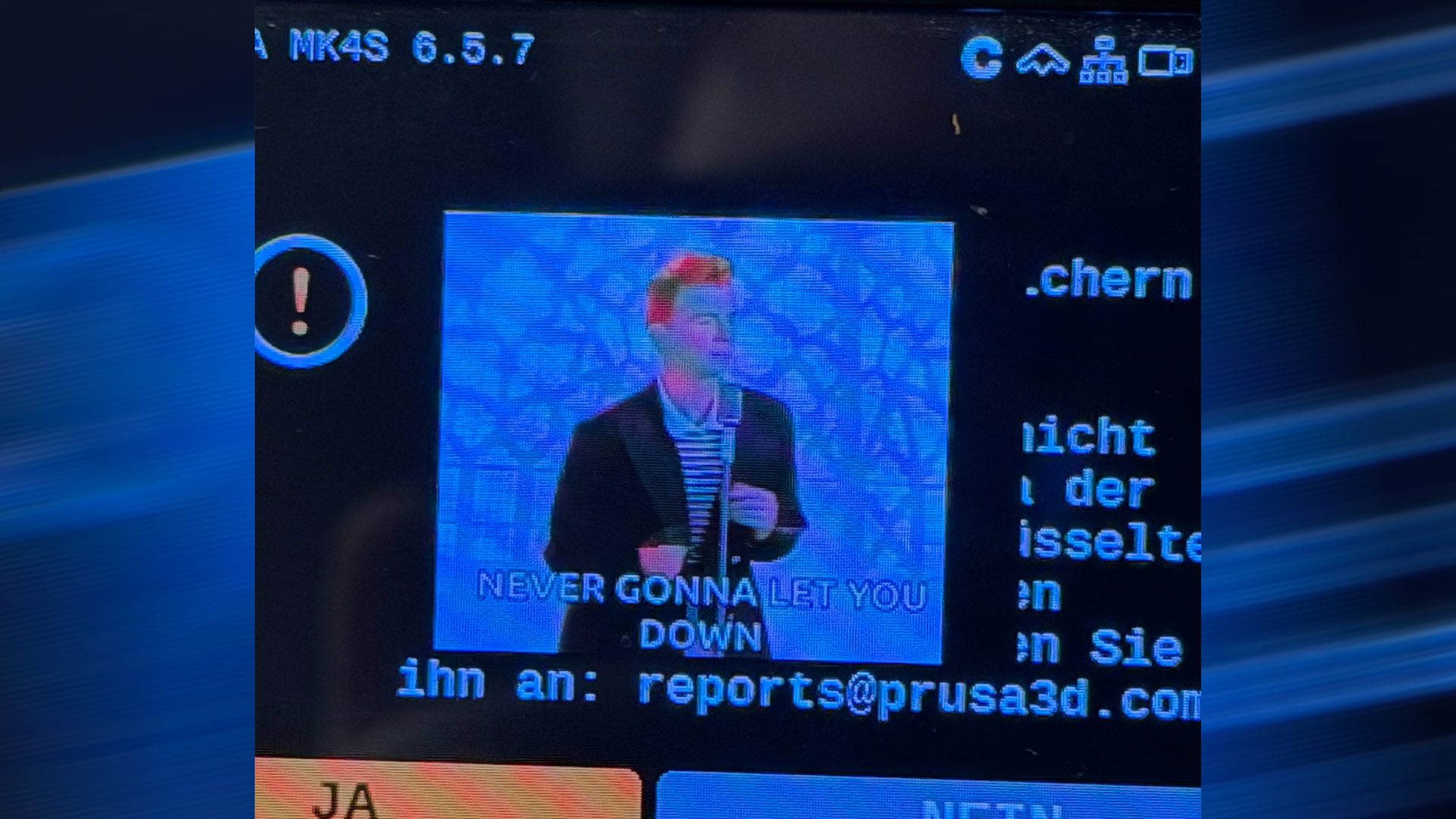
Software engineer Yannick Dixken demonstrated a remote code execution vulnerability in the Prusa MK4S 3D printer, successfully tricking the device into displaying a Rick Astley video. After identifying approximately 23 distinct security flaws over a week-long study, Dixken coordinated with Prusa. The manufacturer has since patched these vulnerabilities in Buddy firmware version 7.0.0 and above, highlighting ongoing risks in connected manufacturing hardware.
Key points
- Yannick Dixken, a software engineer, conducted a security audit on the Prusa MK4S 3D printer to identify potential remote code execution vulnerabilities.
- Dixken discovered roughly 23 individual security defects in the printer's firmware and connected systems during his week-long investigation.
- He successfully demonstrated a proof-of-concept attack by remotely triggering the printer to display a Rick Astley music video, known as a Rickroll.
- Prusa coordinated with Dixken to address the findings and has released Buddy firmware version 7.0.0 and later to patch all identified flaws.
- The incident underscores the security risks associated with internet-connected industrial and consumer hardware, even when used for recreational purposes.
Security Flaws Exposed in Connected 3D Printers
A recent security investigation has shed light on the vulnerabilities present in modern, internet-connected 3D printers. Software engineer Yannick Dixken spent a week conducting a thorough security audit of the Prusa MK4S, a popular model of 3D printer manufactured by the German company Prusa Research. The primary goal of this study was to assess the device's resilience against remote code execution (RCE) attacks, a critical security threat that allows attackers to run arbitrary commands on a target device over a network.
Dixken's research was not merely theoretical; it resulted in the discovery of significant security weaknesses within the printer's software architecture. Over the course of his investigation, he identified roughly 23 individual defects in the system. These vulnerabilities ranged from basic configuration errors to more complex flaws that could potentially allow an unauthorized user to take control of the printer remotely. The findings were documented in a detailed blog post titled "Never gonna print you up!", a playful reference to the viral internet meme associated with the song "Never Gonna Give You Up" by Rick Astley.
The Rickroll Demonstration
To illustrate the severity and nature of these vulnerabilities, Dixken created a video demonstration that has since gone viral in the tech community. In the video, he successfully executed a remote code attack on the Prusa MK4S. The attack did not result in physical damage to the printer or the destruction of printed objects. Instead, Dixken tricked the printer's interface into displaying a video of Rick Astley performing his hit song. This act, known as a "Rickroll," served as a harmless but effective proof-of-concept that the device could be compromised and controlled by an external actor.
The demonstration highlighted how easily a connected device can be manipulated if proper security measures are not in place. While the Rickroll itself is a prank, the underlying capability to execute remote code poses serious risks. In a malicious scenario, an attacker could potentially alter print jobs, steal sensitive data stored on the device, or use the printer as a foothold to attack other devices on the same network.
Industry Response and Patching
Crucially, Dixken did not publish his findings in a vacuum. He coordinated directly with Prusa Research to ensure that the vulnerabilities were addressed responsibly. This collaboration allowed the manufacturer to verify the flaws and develop patches before the details were made public. As a result of this responsible disclosure, Prusa has released updates to its Buddy firmware. All versions of the Buddy firmware greater than 7.0.0 now include patches for the 23 identified defects.
Users of the Prusa MK4S and other compatible models are advised to update their firmware to the latest version to ensure their devices are protected against these specific vulnerabilities. The incident serves as a reminder for both consumers and manufacturers of the importance of secure software development practices in the Internet of Things (IoT) era. As devices become more connected, the attack surface for potential cyber threats expands, making regular security audits and timely patching essential.
Broader Implications for IoT Security
The Prusa MK4S vulnerability is part of a larger trend of security issues emerging in connected consumer and industrial hardware. 3D printers, once isolated machines, are increasingly integrated into networks and cloud services, enabling remote monitoring and control. While this connectivity offers convenience, it also introduces risks that were not present in older, offline models. Security researchers continue to urge manufacturers to prioritize security from the design phase and to maintain transparent communication with the security community regarding discovered flaws.
Key takeaways
- Software engineer Yannick Dixken identified roughly 23 security defects in the Prusa MK4S 3D printer during a week-long audit.
- He demonstrated a remote code execution vulnerability by remotely making the printer display a Rick Astley video.
- Prusa Research coordinated with Dixken and has patched all identified flaws in Buddy firmware version 7.0.0 and above.
- The incident highlights the growing security risks associated with internet-connected manufacturing and consumer hardware.
- Users are urged to update their printer firmware to protect against potential remote exploitation.
Sources
The WireByte editorial team synthesises technology news from multiple primary sources, verifies the facts, and links every source. Articles are produced with AI assistance and reviewed under our editorial policy.