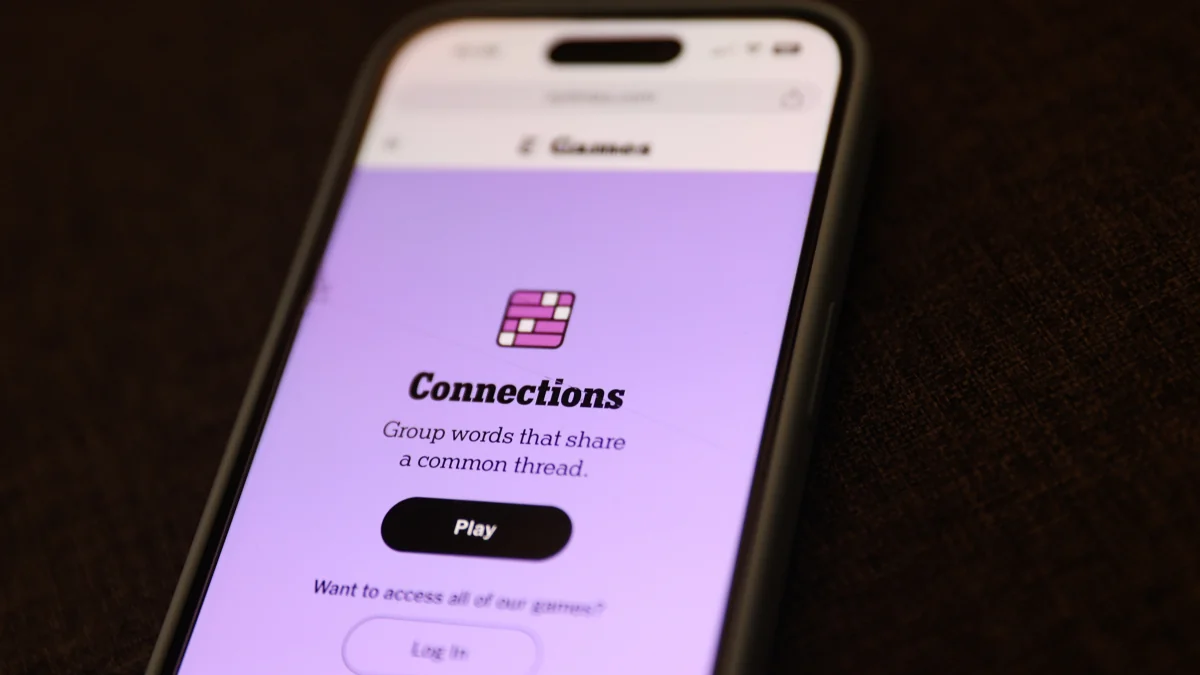
NYT Connections Nov 20 2026 Puzzle Themes and Clues
The New York Times Connections puzzle for November 20, 2026, features word groups centered on expertise, perception, and physical objects. Categories include synonyms for mastery, verbs for noticing, and items ranging from miniature containers to German regional identifiers. The daily challenge tests lateral thinking through semantic associations.
Key points
- The New York Times publishes a daily word puzzle called Connections that challenges users to group words by shared themes.
- The November 20, 2026 edition features categories including synonyms for experts, verbs for noticing, and various physical objects.
- Specific clues include words like Maven, Wizard, and Ace, which relate to skill or mastery in different contexts.
- Other groups involve perception verbs such as Catch, Clock, Register, and Spot, indicating the act of noticing something.
- The puzzle also includes physical items like Teacup, Candelabra, and Cowslip, alongside regional identifiers like Stuttgarter.
- Players must identify these semantic links to solve the puzzle, with hints available for those seeking assistance.
Daily Puzzle Breakdown
The New York Times Connections puzzle for November 20, 2026, presents a fresh set of linguistic challenges for its global audience of daily solvers. This particular edition continues the game's tradition of testing lateral thinking and vocabulary depth by requiring participants to categorize sixteen seemingly unrelated words into four distinct groups. The puzzle design relies on semantic associations, visual puns, and sometimes words with multiple meanings that shift the context entirely. For this date, the themes range from professional expertise to physical objects and regional identifiers, offering a diverse mix of difficulty levels.
Expertise and Mastery
One of the central categories focuses on individuals or entities defined by their high level of skill or knowledge. The words included in this group are Maven, Wizard, and Ace, alongside a fourth term that implies excellence. A Maven is traditionally defined as an expert or connoisseur in a specific field. A Wizard suggests a person with exceptional skill, often metaphorically applied to technology or magic. An Ace denotes a person who is exceptionally good at something. The fourth word in this category, Beast, is used colloquially to describe someone who is formidable or highly capable in their domain. This group tests the solver's ability to recognize synonyms for mastery across different registers of language.
Perception and Noticing
Another significant category revolves around the act of becoming aware of something. The words Catch, Clock, Register, and Spot all function as verbs meaning to notice or realize. To catch a glimpse is to see something briefly. To clock something is to notice or record it, often in a timed context. To register is to become aware of or perceive. To spot is to see or identify something. This group highlights the nuanced ways English speakers describe the moment of perception, requiring solvers to look past the literal definitions and find the common action linking these terms.
Physical Objects and Regional Terms
The remaining categories include a mix of physical items and specific cultural references. One group features small or contained objects such as Teacup, Pocket, and Toy. A Teacup is a small cup for drinking tea. A Pocket is a small bag or pouch. A Toy is an object for play. Another group includes ornate or botanical items like Candelabra, Cowslip, and Miniature. A Candelabra is an ornate candle holder. A Cowslip is a small, low-growing plant. A Miniature refers to something tiny. The final group includes Underground, Stuttgarter, and potentially other location-based or structural terms. Stuttgarter specifically refers to a person from Stuttgart, Germany, adding a geographic dimension to the puzzle. This diversity ensures that solvers must draw on a broad range of knowledge to complete the grid.
Solving Strategy and Community Engagement
Solving Connections often requires identifying the most obvious groups first to eliminate words that might have double meanings. For instance, the word Catch could belong to a sports category or a perception category, depending on the other words present. The availability of hints and spoiler-free explanations on platforms like Mashable helps users understand the logic behind the answers without ruining the experience for future attempts. The puzzle's structure encourages daily engagement, as the themes change every day, keeping the content fresh and challenging for the international community of word game enthusiasts.
Key takeaways
- The NYT Connections puzzle for November 20, 2026, features four distinct word categories.
- One group includes Maven, Wizard, Ace, and Beast, all relating to expertise or mastery.
- Another group consists of Catch, Clock, Register, and Spot, all meaning to notice.
- Physical objects like Teacup, Pocket, Toy, Candelabra, Cowslip, and Miniature form separate groups.
- Stuttgarter is included as a specific regional identifier for a person from Stuttgart.
- Hints and explanations are available to help solvers understand the semantic links.
Sources
The WireByte editorial team synthesises technology news from multiple primary sources, verifies the facts, and links every source. Articles are produced with AI assistance and reviewed under our editorial policy.