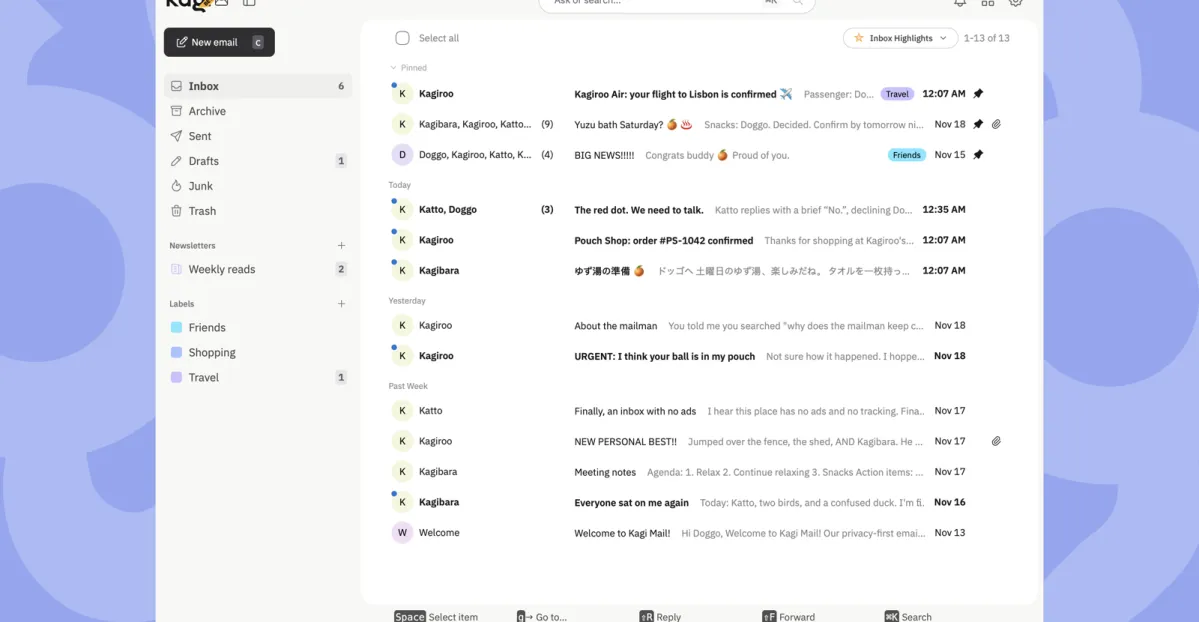
Kagi Launches Public Beta of Privacy-Focused Email Service Kagi Mail
Search alternative Kagi has entered the email market with Kagi Mail, a public beta offering 50GB storage, unlimited aliases, and strict privacy standards. Priced at $99 annually or included in the $25/month Ultimate plan, the service aims to compete with Gmail by eliminating surveillance and ads. Native mobile apps are scheduled for release in mid-2027.
Key points
- Kagi, known for its ad-free search engine and Orion browser, has launched a public beta for Kagi Mail, a new email service designed to rival Gmail.
- The service provides users with a @kagimail.com address, 50GB of storage, unlimited aliases, and a built-in calendar, all while enforcing a no-surveillance and no-ad policy.
- Access requires a $99 annual subscription or inclusion in the $25 monthly Kagi Ultimate plan, following a 60-day free trial period.
- Future features including a contacts address book are planned for Q1 2027, while native mobile applications are not expected until Q3 2027.
- Kagi states the service was built to ensure technology serves users without lock-in, acknowledging competitors like Fastmail and Tuta while differentiating its approach.
Kagi Expands Beyond Search with Email Service
Kagi, the technology company best known for providing an ad-free alternative to Google Search and its proprietary Orion browser, has officially entered the email market. The company announced the public beta launch of Kagi Mail, a new service designed to challenge the dominance of Gmail by prioritizing user privacy and open standards. This move marks a significant expansion for Kagi, which has steadily built a reputation for offering premium digital tools that reject the surveillance-based business models common in the tech industry.
The core offering of Kagi Mail includes a dedicated @kagimail.com email address for each user. However, the service distinguishes itself through technical flexibility, supporting unlimited aliases and custom domains. Users are granted 50GB of storage space and immediate access to a built-in calendar feature. The company emphasizes that the platform operates on open standards, aiming to prevent vendor lock-in and ensure that users retain full control over their data. This approach aligns with Kagi’s broader philosophy that technology should perform its function efficiently without unnecessary interference or data collection.
Pricing and Accessibility
Kagi Mail is not a free service. Access to the platform requires a paid subscription. New users can utilize the service through a 60-day free trial period. After this trial concludes, the cost is set at $99 per year for individual access. Alternatively, the email service is included as part of the Kagi Ultimate subscription, which costs $25 per month. This pricing structure positions Kagi Mail as a premium product, targeting users who are willing to pay for privacy and a clutter-free experience, rather than competing on price with free, ad-supported alternatives.
The company acknowledges that the email market is crowded and that many existing services are well-regarded. In its announcement, Kagi noted that it is a fan of competitors like Fastmail and Tuta, recognizing the quality of work already present in the sector. Despite this, Kagi proceeded with its own development, citing a commitment to building tools that do their job and then step back. The company asked itself whether the world needed another email service, ultimately deciding that the specific values of privacy and user autonomy justified the launch.
Roadmap and Future Development
While the public beta is available now, Kagi has outlined a clear roadmap for future enhancements. The company has confirmed that a contacts address book feature is scheduled for release in the first quarter of 2027. This timeline suggests a phased approach to feature development, allowing the company to stabilize the core email infrastructure before adding more complex organizational tools.
Mobile accessibility is a significant component of this roadmap. Kagi has stated that native mobile applications for iOS and Android are not expected to arrive until the third quarter of 2027. This delay indicates that the company is prioritizing web-based functionality and backend stability in the initial launch phase. The absence of mobile apps in the immediate future may limit the service's appeal to users who rely heavily on smartphone email clients, but it allows Kagi to focus on delivering a robust desktop and web experience first.
Market Context and Significance
The launch of Kagi Mail occurs at a time when consumer trust in major tech platforms is increasingly scrutinized. With Google’s Gmail dominating the market, alternatives that offer privacy without ads are gaining niche but dedicated followings. Kagi’s entry into this space reinforces the growing demand for subscription-based models that prioritize user rights over data monetization. By combining email with its existing search and browser products, Kagi is attempting to create a cohesive ecosystem for privacy-conscious users. The success of Kagi Mail will likely depend on its ability to attract users dissatisfied with current options and its capacity to deliver on its promises of security and ease of use over the next two years.
Key takeaways
- Kagi has launched a public beta for Kagi Mail, a new email service focused on privacy and open standards.
- The service includes 50GB of storage, unlimited aliases, and a built-in calendar, available for a $99 annual fee or $25 monthly subscription.
- A 60-day free trial is offered before the paid subscription begins.
- Native mobile apps are scheduled for release in Q3 2027, with a contacts address book arriving in Q1 2027.
- Kagi positions the service as a premium alternative to Gmail, emphasizing no surveillance and no ads.
Sources
The WireByte editorial team synthesises technology news from multiple primary sources, verifies the facts, and links every source. Articles are produced with AI assistance and reviewed under our editorial policy.