Developer Trains 360M-Parameter Model to Simulate Terminal Interface Without Shell
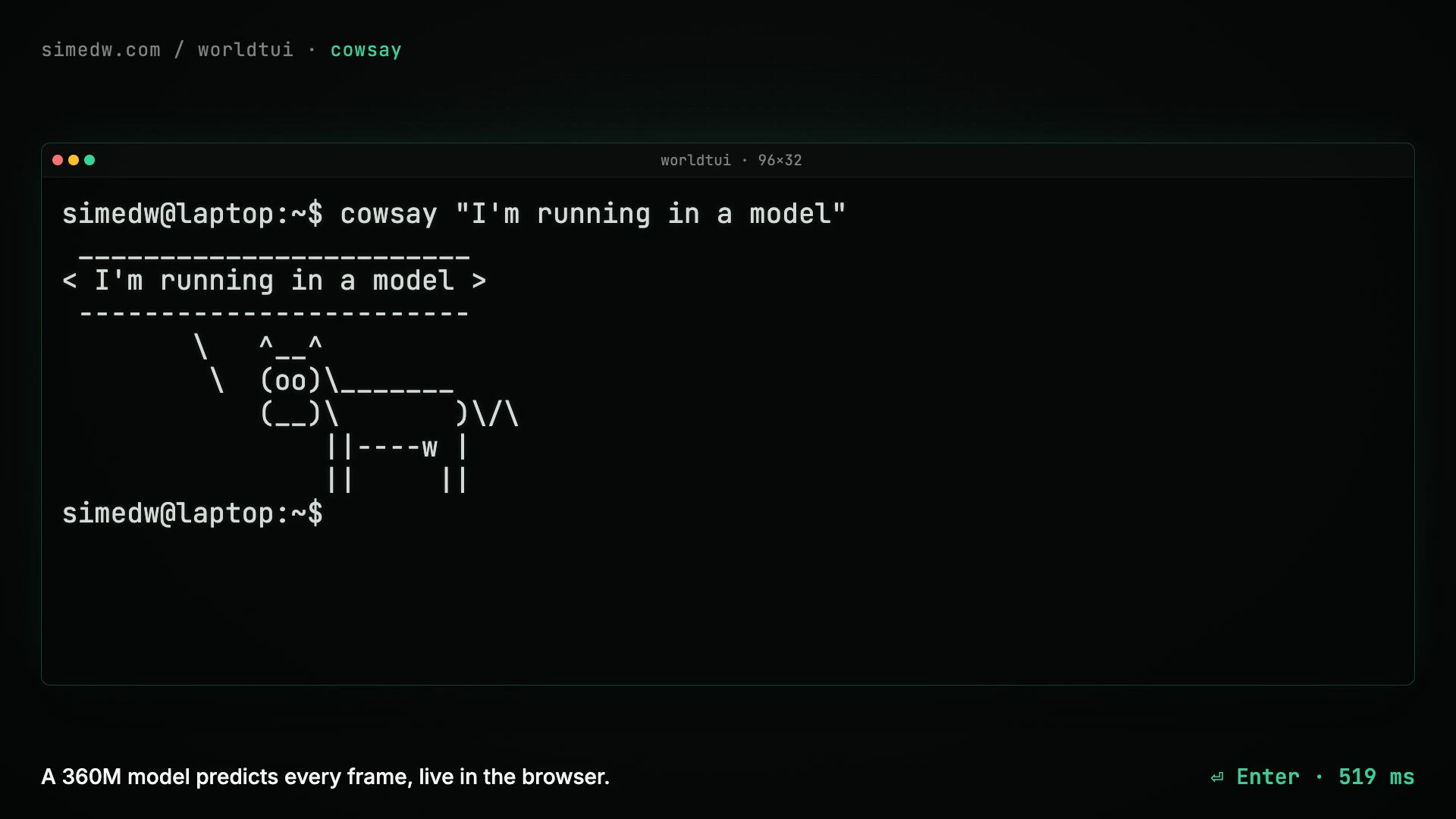
A developer fine-tuned a 360M-parameter language model to function as a terminal emulator, predicting screen changes from user input without an underlying shell or filesystem. The browser-based demo, requiring WebGPU, allows users to run commands like vim and play snake. The project explores 'world models' by testing if the AI maintains a consistent internal state rather than merely generating plausible text, offering a lightweight alternative to massive video-based world models.
Key points
- A developer fine-tuned a 360M-parameter language model to act as a terminal, where the model predicts screen updates based on keypresses without a real shell or filesystem backend.
- The 208 MB browser-based demo requires WebGPU and a physical keyboard, functioning optimally on desktop browsers like Chrome or Edge, while running slowly on mobile devices.
- The model can execute commands such as creating files, running vim and tmux, and playing snake, while retaining context of previous commands to maintain a consistent world state.
- The project was inspired by Genie 3, aiming to test if a model can learn application behavior rather than relying on code, using a character grid instead of pixels to reduce data requirements.
- Training data was generated by running real shells to create perfectly labelled examples, leveraging the pretrained model's existing knowledge of standard Unix commands like ls and cat.
- The primary technical challenges involved teaching the model to repair its own mistakes and decoding screen rows in parallel to ensure responsive and accurate terminal simulation.
A developer has released a 360M-parameter language model fine-tuned to simulate a terminal interface, operating without an underlying shell or filesystem. The model predicts how the screen changes in response to user input, effectively acting as a world model for a text-based environment. The project stems from the developer's interest in applications that are learned rather than written in code, inspired by recent advances in video-based world models like Genie 3. By scaling down the ambition from pixel-based game worlds to a character grid, the developer utilized the fact that terminals generate easily labelled training data and that pretrained language models already possess knowledge of standard command-line utilities.
The browser-based demo, which is 208 MB in size, requires WebGPU support and is optimized for desktop browsers such as Chrome or Edge. Users can interact with the model by typing commands to create files, run text editors like vim, manage processes with tmux, or play games like snake. A key feature of the model is its ability to maintain a consistent internal state, remembering previous commands and context. To verify this consistency, the demo includes a test where typing a misspelled command like "pythoon" reveals that the model is not a real shell but a predictive simulation.
The development process focused on two major technical hurdles: teaching the model to repair its own mistakes and decoding screen rows in parallel. While the model performs well on desktop, it runs slowly on mobile devices. This project demonstrates the potential of smaller, specialized models to replicate complex software behaviors, offering a glimpse into a future where applications are defined by learned patterns rather than explicit code.
Sources
The WireByte editorial team synthesises technology news from multiple primary sources, verifies the facts, and links every source. Articles are produced with AI assistance and reviewed under our editorial policy.