Anthropic Launches Claude Personal Finance Tool with Read-Only Bank Access
Anthropic has launched a Personal Finance feature for Claude, allowing US subscribers to connect bank accounts via Plaid. The read-only tool analyzes spending and balances without moving funds or offering investment advice. It distinguishes itself by not using chat data for model training, positioning itself as a neutral financial companion amid growing AI integration in banking.
Key points
- Anthropic, the AI company behind the Claude chatbot, has launched a Personal Finance feature for Pro, Max, and Ultra subscribers in the US.
- Users connect bank and credit card accounts via Plaid, granting Claude read-only access to view balances, limits, and up to two years of transaction history.
- The tool analyzes spending by category and answers questions about affordability, but explicitly cannot move, manage, or invest money.
- Anthropic states that conversations within the Personal Finance hub are not used to train its models, a key privacy distinction from competitors.
- The launch positions Claude to compete with OpenAI’s ChatGPT Finances, which introduced similar capabilities in May 2024.
- The feature includes no ads, sponsored recommendations, or proprietary financial products, aiming to provide neutral financial insights.
Anthropic has officially introduced a Personal Finance feature for its Claude AI chatbot, marking a significant step in the integration of artificial intelligence into personal financial management. The new tool is available to Pro, Max, and Ultra subscribers in the United States and allows users to securely link their bank and credit card accounts to the chatbot. By partnering with Plaid, a widely used financial data aggregator, Claude can access account information without requiring users to share their banking passwords directly with the AI company.
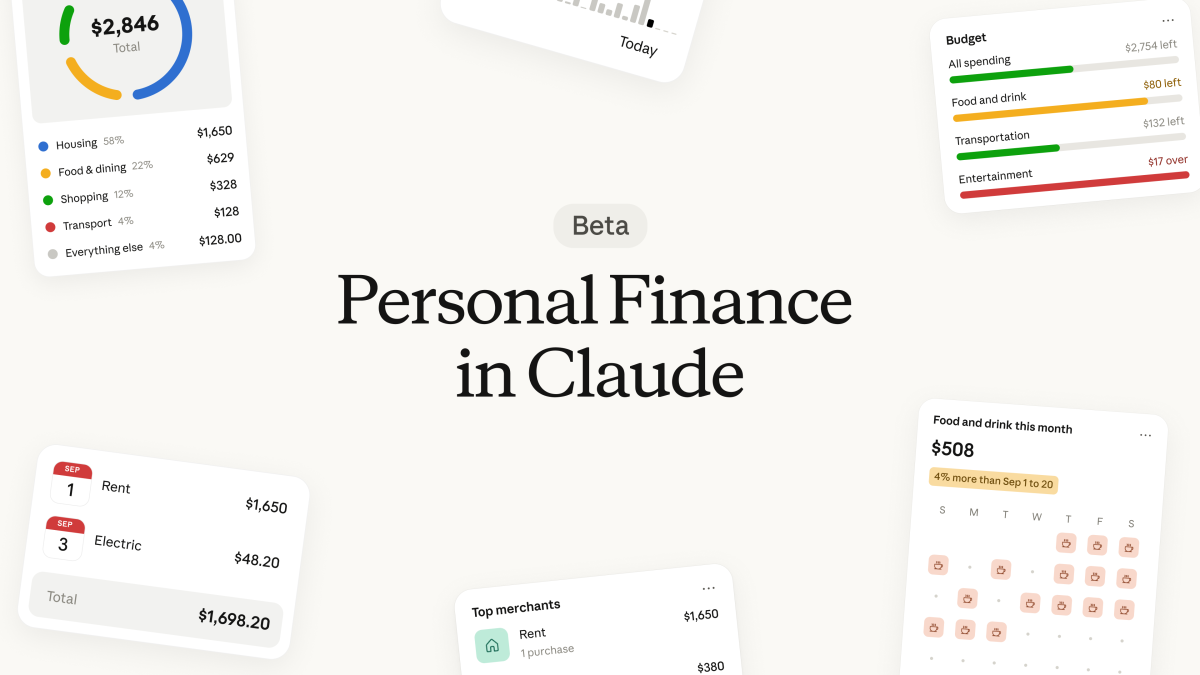
The core functionality of the Personal Finance feature is designed to help users understand their spending habits and financial standing. Users can ask questions such as where their money went during a specific month, and Claude will provide a breakdown of spending by categories like rent, utilities, shopping, and food. The tool can also answer broader financial queries, such as whether a user can afford a vacation in six months, how many bills remain before their next payday, and potential monthly savings. Additionally, it can explain complex financial terms in everyday language, making it accessible to users with varying levels of financial literacy.
A critical aspect of the feature’s design is its read-only access. Anthropic emphasizes that Claude cannot move, manage, or invest user money. The company explicitly states that the tool is not designed to provide investment advice. This limitation is intended to mitigate risks associated with AI-driven financial actions and to ensure that users retain full control over their funds. The access is facilitated through Plaid, which verifies the connection and ensures that Claude only sees the bank’s name, account type, the last four digits of the account number, balances, credit limits, and up to two years of transaction history.
Privacy concerns are central to Anthropic’s pitch for this feature. In an era where data privacy is a major concern, Anthropic has distinguished its offering by stating that conversations within the Personal Finance hub are not used to train its underlying models. This is a significant departure from some competitors, as OpenAI’s ChatGPT Finances applies existing data control settings, which may allow for data usage depending on user preferences. Anthropic’s approach aims to reassure users that their sensitive financial data remains isolated within the specific context of their queries.
The launch of Claude’s Personal Finance tool places Anthropic in direct competition with OpenAI, which introduced a similar feature in May 2024. Both tools allow users to connect financial accounts and receive insights based on their spending patterns. However, Anthropic is highlighting differences in its business model and data practices. The company notes that Claude’s Personal Finance feature contains no ads, sponsored recommendations, or proprietary financial products such as credit cards or loans. This neutrality is presented as a benefit, ensuring that users receive straight answers without commercial bias.
The integration of financial data into AI chatbots reflects a broader trend in the tech industry toward more personalized and proactive digital assistants. By allowing Claude to analyze transaction history and balances, Anthropic is positioning the chatbot as a comprehensive financial companion rather than just a general-purpose AI. This move could influence how users interact with their finances, potentially shifting some financial management tasks from traditional banking apps to AI-driven interfaces.
Security and trust remain paramount in this space. The reliance on Plaid adds a layer of security, as the financial institution’s backend verifies the connection. This prevents unvetted AI bots from crawling through accounts and ensures that only approved applications can access financial data. Anthropic’s insistence on read-only access and non-training data policies is an attempt to build trust among users who are increasingly cautious about sharing sensitive information with AI systems.
As the feature rolls out to US subscribers, the industry will be watching to see how users adopt the tool and what feedback emerges regarding its accuracy and usefulness. The success of Claude’s Personal Finance feature could set a precedent for how AI companies handle sensitive data and compete in the financial technology sector. For now, Anthropic is focusing on providing a secure, neutral, and insightful experience for users looking to make sense of their financial lives through AI.
Sources
The WireByte editorial team synthesises technology news from multiple primary sources, verifies the facts, and links every source. Articles are produced with AI assistance and reviewed under our editorial policy.